
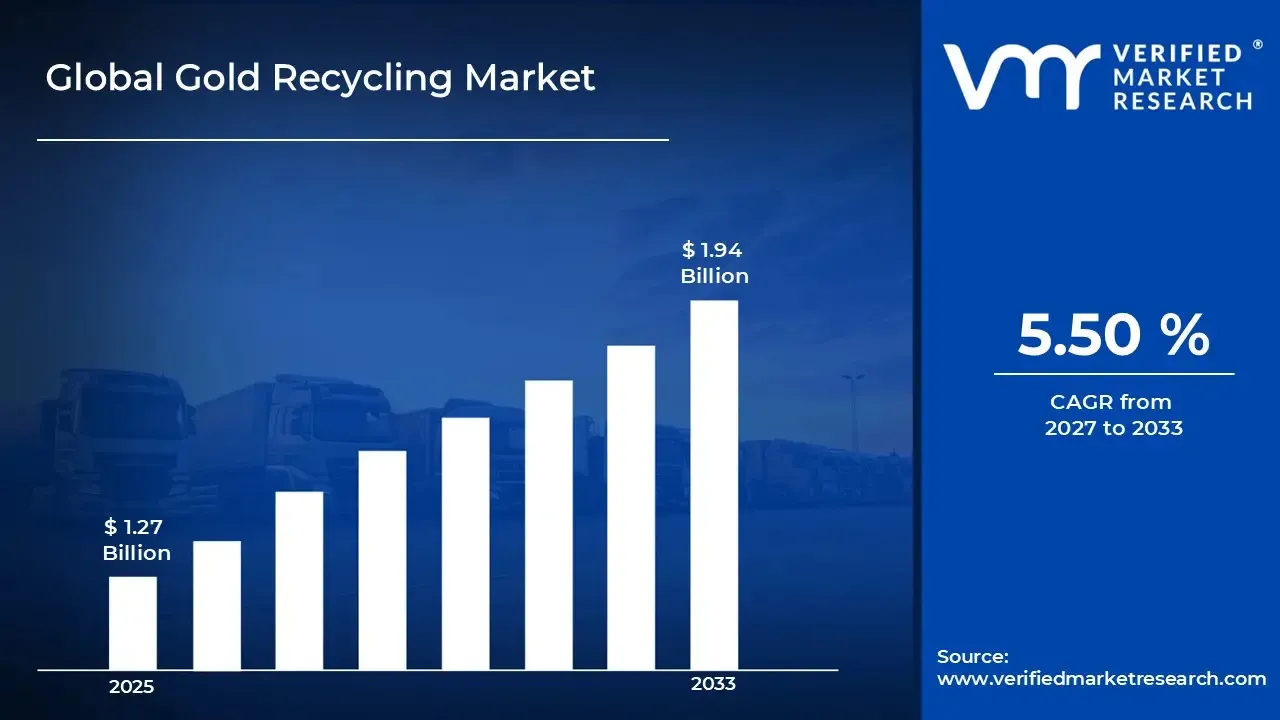
The Global Gold Recycling Market is expanding steadily as industrial buyers, jewelry manufacturers, and electronics producers increasingly turn to secondary gold sources to stabilize supply and manage cost volatility. Rising regulatory emphasis on responsible sourcing, waste traceability, and hazardous material handling is pushing recyclers to formalize collection and strengthen documentation across the value chain. Advances in pyrometallurgical and hydrometallurgical processing technologies are improving recovery efficiency for mixed-grade scrap, widening the addressable feedstock base. According to Verified Market Research®, the Gold Recycling Market Size is set to grow from USD 1.27 Billion in 2025 to USD 1.94 Billion by 2033, reflecting sustained momentum in circular gold sourcing models.
Lewes, Delaware, Aug. 24, 2026 (GLOBE NEWSWIRE) -- The Gold Recycling Market Size was valued at USD 1.27 Billion in 2025 and is projected to reach USD 1.94 Billion by 2033, registering a compound annual growth rate (CAGR) of 5.5% over the 2025–2033 forecast period, according to a new industry analysis released by Verified Market Research®. The report, titled “Gold Recycling Market Size By Type (Pure Gold, High Purity Gold), By Application (Pyrometallurgical, Hydrometallurgical), By Geographic Scope And Forecast,” provides a comprehensive assessment of market drivers, restraints, opportunities, competitive dynamics, and regional trends shaping the Global Gold Recycling Market through the end of the forecast horizon. The analysis covers five regions, four segments, and eleven key players profiled across more than 240 pages of research.
Download a free sample to access exclusive Insights, Data Charts, And Forecasts From Gold Recycling Market Sample Report
Gold Recycling Market Overview
The Gold Recycling Market represents the end-to-end economic activity of recovering gold from secondary sources and returning it to form factors suitable for industrial use or further refining. Market participation includes the physical collection and processing of gold-bearing materials, along with the enabling metallurgical systems that convert scrap streams into reusable gold outputs. The scope of the Gold Recycling Industry covers the technologies and processing routes used to separate gold from mixed matrices, remove impurities, and produce saleable gold material capable of re-entering upstream manufacturing and investment supply chains.
Within this market, the core function extends beyond the simple purchase of scrap. It centers on transforming contaminated or composite gold-bearing inputs into gold outputs with defined purity and performance characteristics. Feedstock may originate from industrial residues, manufacturing scrap, e-waste streams containing precious metal content, jewelry and consumer scrap, or other gold-bearing secondary materials, provided the economic activity culminates in recovered gold returned to market-ready form factors.
To maintain analytical precision, the Gold Recycling Market Forecast explicitly excludes several adjacent activities. Primary gold mining and ore processing are excluded because their technology and value chain position focus on extracting gold from virgin ore rather than recovering it from secondary sources. Metal trading or brokerage of scrap without processing is also excluded, as it does not reflect the metallurgical conversion steps that define recycling economics and quality outcomes. Similarly, refining of purchased doré or refined feed that is not derived from recycling streams falls outside the scope, since the report is centered on recycling-led recovery routes and their application-specific processing stages.
This scope discipline matters because the Gold Recycling Market behaves less like a single commodity chain and more like a set of parallel recovery pathways that respond differently to feedstock characteristics, purity targets, and processing constraints. Gold recycling volumes do not translate uniformly into output value; the market's value distribution depends on the ability to produce the required gold grade, recover associated precious and base metals, and meet downstream specifications that determine what buyers are willing to pay.
Download a free sample to access exclusive Insights, Data Charts, And Forecasts From Gold Recycling Market Sample Report
Gold Recycling Market Growth Drivers
The Gold Recycling Market growth outlook is primarily driven by the tightening link between gold prices and secondary recovery economics, alongside expanding regulatory pressure and continuous improvement in recovery technology. Verified Market Research® identifies three principal drivers underpinning the market's 5.5% CAGR through 2033.
Raw Material Price Volatility
When gold prices fluctuate, refiners and jewelry and electronics producers face higher input-cost risk and tighter margins. Recycling responds by converting variable scrap supply into more predictable internal feedstock, where higher recovery rates reduce reliance on newly mined material. As volatility persists into multi-year budgeting cycles, contracts and procurement strategies shift toward recyclers that can deliver consistent output quality and throughput, reinforcing demand across the Gold Recycling Market.
Stricter Waste, Traceability, and Responsible Sourcing Rules
Regulatory frameworks increasingly require documented material sourcing, waste handling, and reporting for metals recovery, pushing regulated firms to demonstrate the origin and disposition of gold-containing waste. This creates direct demand for recycling capacity that can accept diverse scrap types and provide audit-ready documentation across processing batches. Compliance intensity strengthens the procurement pipeline for recycling services and supports longer-term offtake arrangements within the Gold Recycling Industry.
Advances in Hydrometallurgical and Pyrometallurgical Control Systems
New process control, pre-treatment optimization, and improved separation performance reduce losses when scrap composition varies across industries and regions. Better yield and lower contamination translate into more usable recycled output, supporting adoption by refiners seeking to diversify feedstock without sacrificing specifications. As these improvements scale, recyclers can handle broader scrap availability, converting fragmented supply into higher effective recovery and expanding addressable volumes for the Gold Recycling Market.
These core drivers are reinforced by broader ecosystem evolution. Growing collection networks for jewelry, industrial components, and electronic scrap improve scrap availability and reduce logistics friction, while standardization of sorting and assay practices lowers uncertainty in pricing and recovery planning. Capacity expansion and consolidation among recyclers further supports stable processing runs, helping absorb demand swings created by gold price movement and compliance-driven ordering.
Driver intensity also differs by segment. For Pure Gold, process and yield improvement is the dominant driver, reducing cost per gram of usable output by minimizing losses during refining. For High Purity Gold, compliance and traceability requirements dominate, as buyers require stronger provenance and tighter quality assurance. On the application side, Pyrometallurgical processing is driven by raw material volatility and operational cost stability tied to steady furnace utilization, while Hydrometallurgical processing is propelled primarily by technology-driven recovery efficiency gains in leaching, separation, and process control.
Emerging Opportunities in the Gold Recycling Market
Verified Market Research® identifies several opportunity areas positioned to shape Gold Recycling Market Growth through 2033.
- Higher-yield sorting and pre-treatment: Systems that better separate gold-bearing fractions from mixed electronics, jewelry, and industrial residues can reduce early-cycle losses and stabilize feed composition for downstream processing, converting previously discounted scrap streams into saleable outputs.
- Expansion of hydrometallurgical recovery for complex scrap: Hydrometallurgical routes are increasingly viable for materials difficult to process through purely thermal methods due to fine particle gold distribution or heterogeneous matrix effects, particularly as safety and lower-waste flows become operational priorities.
- Localization of recycling capacity near high-scrap demand centers: Deploying modular recycling units or contract-based tolling arrangements near demand clusters can shorten logistics cycles, reduce time-in-process, and unlock feed availability currently stranded off-grid.
These opportunities are not distributed evenly across the market. For Pure Gold, the opportunity centers on feed-grade consistency and quality assurance, where operators that reliably produce tighter specification outputs face fewer downstream rejections and can command more stable offtake terms. For High Purity Gold, the opportunity relates to purification capability and impurity control, with facilities that close purity gaps through improved pre-treatment and downstream polishing gaining a steeper but more concentrated growth trajectory. By application, Pyrometallurgical opportunity is linked to thermal efficiency and throughput economics, while Hydrometallurgical opportunity is tied to reagent management, safety, and environmental compliance for difficult-to-treat inputs.
Download a free sample to access exclusive Insights, Data Charts, And Forecasts From Gold Recycling Market Sample Report
Gold Recycling Market Challenges and Restraints
Despite favorable growth dynamics, the Gold Recycling Market faces several structural restraints that Verified Market Research® highlights as relevant to investment and operating decisions.
Regulatory Complexity and Traceability Burdens
Gold Recycling Market operators face layered requirements around hazardous materials handling, worker safety, and end-use traceability. These obligations are structurally difficult for smaller recyclers because they require audits, documentation systems, and periodic reporting that must align across jurisdictions. The resulting compliance overhead can delay capacity commissioning and reduce willingness to invest in new processing lines.
Feedstock Variability and Competing Uses for Scrap Gold
Gold recycling economics depend on consistent input quality and predictable volumes, yet scrap streams are uneven across time, geography, and buyer qualification rules. When feedstock chemistry diverges, operators incur extra separation and refining steps to reach saleable specifications for Pure Gold and High Purity Gold, increasing unit costs and weakening pricing power.
Process Yield Constraints and Impurity Management
Both pyrometallurgical and hydrometallurgical pathways must address impurities that affect recovery rates, downstream refining, and tailings treatment. When impurity loads rise, recovery efficiency can decline, requiring additional reagents, energy, filtration time, or polishing steps to achieve target grades increasing variable operating costs and reducing plant utilization.
These restraints are amplified at the ecosystem level by supply chain bottlenecks, where scrap aggregation, logistics, and qualification processes do not align with processing capacity schedules. Fragmentation and limited standardization of scrap composition increase the burden of pre-processing and testing, while geographic and regulatory inconsistencies further extend timelines and complicate cross-border sourcing of feedstock.
Technology and Innovation Trends
Technology is a primary determinant of capability, efficiency, and adoption across the Gold Recycling Market, given that recycling routes must reliably convert diverse feedstocks into saleable gold fractions such as Pure Gold and High Purity Gold. Verified Market Research® identifies three key innovation areas shaping the Gold Recycling Industry through 2033.
Smelting and Slag Chemistry Optimization
Thermal processing is increasingly tuned through tighter control of slag formation, oxidizing conditions, and material handling strategies, reducing gold losses to slag despite feed heterogeneity. This directly addresses performance volatility in the pyrometallurgical route, supporting higher practical recovery consistency and fewer batch-to-batch quality fluctuations.
Adaptive Leaching and Impurity Management
Hydrometallurgical innovations focus on making leaching more resilient to different surface states, alloy matrices, and impurity profiles occurring in jewelry, electronics, and industrial residues. As impurity handling becomes more robust, more feedstock categories can be routed through hydrometallurgical systems, improving capacity utilization and enabling steadier production of High Purity Gold.
Integrated Refining Sequences
Innovations in refining sequence design focus on maintaining gold specification compliance when starting material composition is irregular. By strengthening the logical linkage between concentration, purification, and final finishing steps, facilities can reduce the probability of trace-level impurities reappearing during transitions between process stages, improving yield-to-spec across runs.
Beyond these innovation areas, the industry's Market Trends point toward a more process-divided and quality-segmented structure between 2025 and 2033. Recyclers are increasingly aligning incoming feed characteristics with the most appropriate recovery route, creating clearer operational boundaries between pyrometallurgical and hydrometallurgical processing. Pre-processing and sorting are becoming a strategic step rather than an administrative one, and selective integration of capabilities such as refining control systems and testing infrastructure is reshaping competitive positioning across the value chain.
Industry Use Cases and End-User Applications
The Gold Recycling Market manifests through several operational use-cases in which feedstock chemistry, impurity profiles, and desired product specifications determine whether recycling capacity is deployed around thermal processing or solution-based recovery.
Electronic Scrap Recovery
Recycling operators process end-of-life electronics, including circuit boards and connector scrap, that arrive with complex impurity loadings. Operational relevance centers on pre-sorting, leaching or thermal treatment to break down gold-bearing phases, and subsequent purification steps ensuring recovered metal meets downstream use requirements. This use-case drives demand because electronics scrap is recurring and supply is distributed.
Industrial Jewelry and Manufacturing Scrap Loops
Scrap generated near production sites is often consolidated for processing. Recycling systems are selected to minimize downtime and maintain continuity of material supply for refineries or casting workflows that require reliable gold chemistry. Demand is influenced by the repeat generation of internal scrap and the need to reduce material loss.
Commercial Bullion and Refinery Integration
Recycling streams may include returns, off-spec material, or transitional stock from refining operations. Here, recycling is deployed as a complementary step to existing metallurgy assets, with system design tuned to impurities that commonly appear in the specific upstream supply chain, reducing the risk of contamination carrying into final refining stages.
Segmentation shapes how these use-cases are deployed at the facility level. Pure Gold-oriented output specifications align with process trains that prioritize bulk recovery pathways and impurity minimization sufficient for immediate remelting, while High Purity Gold-focused deployment requires tighter control and more extensive purification sequencing.
Download a free sample to access exclusive Insights, Data Charts, And Forecasts From Gold Recycling Market Sample Report
Gold Recycling Market Regional Outlook
In the Gold Recycling Market, regional behavior reflects differences in scrap availability, processing economics, and the pace at which advanced recovery methods scale from pilot operations to commercial throughput. Asia Pacific leads the Global Gold Recycling Market with approximately 40% market share, driven by electronics demand and large jewelry markets.
North America
North America presents a mature, compliance-driven market structure, where stable industrial end-use and established refining capabilities shape consistent demand for recycled gold. Demand is reinforced by the region's concentration of precision manufacturing and electronics-related scrap streams. Regulatory expectations around worker safety, waste handling, emissions control, and downstream product integrity create process discipline, favoring facilities that can manage reagent inputs for hydrometallurgical operations and control emissions for pyrometallurgical lines. Key factors shaping the region include end-user and scrap-stream concentration, compliance-first operating models, adoption of process control and traceability, capital availability for throughput upgrades, supply chain maturity for collection and sorting, and enterprise demand for specification-consistent output.
Europe
Europe operates as a regulation-led and quality-disciplined environment, where compliance expectations shape both collection practices and refining outputs. Regulatory frameworks and harmonized rules for waste handling, material tracking, and precious metal purity drive consistent sampling, documentation, and traceability across member states. Key factors include EU-wide regulatory discipline on waste and scrap handling, environmental limits that steer process selection between thermal and solution-based routes, traceability requirements that raise the importance of standard certification, cross-border scrap flows that amplify demand for harmonized specifications, regulated innovation pathways emphasizing controlled upgrades, and institutional procurement that stabilizes demand.
Asia Pacific
Asia Pacific operates as a high-expansion basin driven by fast-moving industrial buildout and sustained end-user demand, and it leads the Gold Recycling Market with approximately 40% market share, driven by electronics demand and large jewelry markets. Growth patterns diverge between developed industrial economies such as Japan and Australia and rapidly scaling markets across India and parts of Southeast Asia, where expanding manufacturing capacity and urban consumption accelerate scrap availability and recovery needs. Key factors include industrial expansion and recycling-linked manufacturing, population scale and urban consumption dynamics, cost competitiveness through ecosystem depth, infrastructure growth and urban expansion, uneven regulatory execution across countries, and investment momentum tied to government-led industrial initiatives.
Latin America
Latin America represents an emerging segment in the Gold Recycling Market, with adoption gradually expanding as formal collection systems, refining capacity, and industrial compliance practices develop. Demand is shaped by key economies including Brazil, Mexico, and Argentina, where jewelry cycles, artisanal and small-scale mining byproducts, and industrial scrap streams influence recoverable gold availability. Key factors include currency-driven demand stability, uneven industrial development across countries, dependence on external supply chains, infrastructure and logistics constraints, regulatory variability and policy inconsistency, and gradual investment and market penetration.
Middle East & Africa
The Middle East & Africa region behaves as a selectively developing market rather than a uniformly expanding one. Demand formation is shaped by Gulf economies, South Africa's established minerals value chain, and a smaller set of urban centers where jewelry, electronics, and institutional procurement concentrate secondary gold inputs. Key factors include policy-led industrial diversification in Gulf economies, infrastructure gaps and uneven industrial readiness, high reliance on imports and external supply chains, concentrated demand in urban and institutional centers, regulatory inconsistency across countries, and gradual market formation through strategic projects.
Download a free sample to access exclusive Insights, Data Charts, And Forecasts From Gold Recycling Market Sample Report
Gold Recycling Market Competitive Landscape
The Gold Recycling Market Competitive Landscape is characterized by a mix of specialized recyclers and vertically integrated industrial players, resulting in a competitive structure that is neither purely fragmented nor fully consolidated. Competition is driven by feedstock access and trust-based offtake relationships, as well as process capability across pyrometallurgical and hydrometallurgical routes, compliance readiness, and the ability to deliver consistent gold quality aligned with Pure Gold and High Purity Gold specifications.
Key players profiled in the report include:
- Umicore SA - leads the market due to stable purity outcomes across pyrometallurgical and hydrometallurgical pathways, leveraging metallurgical and refining know-how to convert diverse secondary materials into saleable outputs with predictable specifications.
- Tanaka Holdings Co Ltd - a specialist focused on precious metal refining technologies and production systems designed for high-value recovery, differentiated by process discipline supporting consistent output quality from heterogeneous inputs.
- Johnson Matthey plc - an industrial-scale technology and refining participant whose competitive leverage comes from translating processing know-how into repeatable operational pathways supporting higher-purity outcomes.
- Heraeus Holding GmbH - differentiated through expertise in high-grade precious metal processing and the ability to supply refined outputs aligned with stringent quality needs.
- Royal Canadian Mint - a market-facing institutional refiner contributing to competitive structure through credibility, custody-focused sourcing practices, and refinement standards tied to official-grade requirements.
- ARE Holdings Inc
- Aurubis AG
- Elemetal LLC
- Sino-Platinum Metals Co Ltd
- Abington Reldan Metals LLC
- GEM Co Ltd
Other participants collectively broaden the competitive field by covering additional geographic reach, niche feedstock strengths, and alternative processing capabilities. Several regional or specialist players compete through responsiveness to localized supply, targeted expertise in particular residue types, and flexible contracting, while broader industrial recyclers contribute scale effects and process know-how that can accelerate adoption of cleaner, more controlled refining pathways. Competitive intensity is expected to evolve toward specialization in recovery performance and compliance outcomes, with selective consolidation around operators that can sustain yield, deliver consistent purity, and manage regulatory risk across both pyrometallurgical and hydrometallurgical routes through 2033.
Download a free sample to access exclusive Insights, Data Charts, And Forecasts From Gold Recycling Market Sample Report
Gold Recycling Market Segmentation
By Type
- Pure Gold
- High Purity Gold
By Application
- Pyrometallurgical
- Hydrometallurgical
By Geography
- North America
- Europe
- Asia Pacific
- Latin America
- Middle East & Africa
High Purity Gold is the dominant segment due to stringent downstream purity specifications driving contracts, while Pure Gold remains a broader volume category supported by wide applicability across industrial and manufacturing use cases. On the application side, Pyrometallurgical routes benefit from established unit operations and cost competitiveness for suitable feedstocks, while Hydrometallurgical routes gain share where selective recovery and lower contamination concerns are operational priorities.
Strategic Outlook Through 2033
Verified Market Research® expects the Gold Recycling Market to sustain its 5.5% CAGR trajectory through 2033, supported by continued gold price sensitivity, expanding compliance-driven traceability requirements, and improving recovery technologies. Capital allocation trends indicate that investment will increasingly favor gold recycling systems that combine scale with operational certainty, with consolidation dynamics suggesting pressure toward larger, better-integrated recyclers. Project and equity signals in the broader gold industry support technology upgrades that improve yield consistency for both Pure Gold and High Purity Gold outputs.
Investment focus areas most relevant to the Gold Recycling Market Forecast include consolidation and royalty-style revenue expansion, capacity and feedstock access as a core growth lever, targeted project funding and development de-risking, and partnerships that monetize output without full balance-sheet risk. As capital is directed toward throughput, contractual stability, and performance-backed process innovation, the market's segment dynamics are likely to shift toward operators that can fund and execute reliable recovery pathways across both pyrometallurgical and hydrometallurgical applications.
Strategic prioritization across the Gold Recycling Market Opportunity Map should balance the scale advantages of capacity expansion with the execution risk of integrating new input sources and technology pathways. Investors and operators that can underwrite feedstock reliability and product-grade differentiation are positioned to gain stronger near-term utilization, while teams focused on hydrometallurgical selectivity or pyrometallurgical throughput improvements may unlock longer-term margin resilience through the 2033 forecast horizon.
Related Reports
Global Cyanide For Gold Mining Market Size By Type (Sodium Cyanide, Calcium Cyanide), By Application (Heap Leaching, CIP, CIL), By End-User Industry (Mining Companies, Chemical Suppliers), By Geographic Scope And Forecast
Global High Purity Gold Potassium Cyanide Market Size By Form (Powder, Solution), By Application (Electronics, Jewelry, Chemicals), By End-User (Semiconductor Industry, Electroplating Industry, Laboratories), By Geographic Scope And Forecast
Global Conductive Gold Paste Market Size By Type (Aqueous Conductive Gold Paste, Non-Aqueous Conductive Gold Paste), By Application (Electronics, Solar Cells, LEDs, Automotive, Medical Devices), By End-User (Consumer Electronics, Industrial Manufacturing, Healthcare, Telecommunications, Aerospace), By Geographic Scope And Forecast
Global Gold Concentrate Market Size By Type (Sulphide Ore Concentrate, Oxide Ore Concentrate), By Application (Processing Plants, Smelting Facilities, Jewelry Industry, Electronics), By End User (Mining Companies, Metal Refiners, Industrial Manufacturers), By Geographic Scope And Forecast
Global Gold Leaf Market Size By Product Type (Genuine Gold Leaf, Imitation Gold Leaf), By Purity (24 Karat, 22 Karat and Below), By Application (Arts and Crafts, Food and Beverages, Architecture and Interior Decoration, Religious and Cultural Uses, Cosmetics), By Geographic Scope And Forecast
Visualize Gold Recycling Market using Verified Market Intelligence -:
Verified Market Intelligence is our BI Enabled Platform for narrative storytelling in this market. VMI offers in-depth forecasted trends and accurate Insights on over 20,000+ emerging & niche markets, helping you make critical revenue-impacting decisions for a brilliant future.
VMI provides a holistic overview and global competitive landscape with respect to Region, Country, Segment, and Key players of your market. Present your Market Report & findings with an inbuilt presentation feature saving over 70% of your time and resources for Investor, Sales & Marketing, R&D, and Product Development pitches. VMI enables data delivery In Excel and Interactive PDF formats with over 15+ Key Market Indicators for your market.
About Us
Verified Market Research® stands at the forefront as a global leader in Research and Consulting, offering unparalleled analytical research solutions that empower organizations with the insights needed for critical business decisions. Celebrating 10+ years of service, VMR has been instrumental in providing founders and companies with precise, up-to-date research data.
With a team of 500+ Analysts and subject matter experts, VMR leverages internationally recognized research methodologies for data collection and analyses, covering over 15,000 high impact and niche markets. This robust team ensures data integrity and offers insights that are both informative and actionable, tailored to the strategic needs of businesses across various industries.
VMR's domain expertise is recognized across 14 key industries, including Semiconductor & Electronics, Healthcare & Pharmaceuticals, Energy, Technology, Automobiles, Defense, Mining, Manufacturing, Retail, and Agriculture & Food. In-depth market analysis cover over 52 countries, with advanced data collection methods and sophisticated research techniques being utilized. This approach allows for actionable insights to be furnished by seasoned analysts, equipping clients with the essential knowledge necessary for critical revenue decisions across these varied and vital industries.
Verified Market Research® is also a member of ESOMAR, an organization renowned for setting the benchmark in ethical and professional standards in market research. This affiliation highlights VMR's dedication to conducting research with integrity and reliability, ensuring that the insights offered are not only valuable but also ethically sourced and respected worldwide.
CONTACT: Mr. Edwyne Fernandes

Verified Market Research®

US: +1 (650)-781-4080

US Toll Free: +1 (800)-782-1768

Email: sales@verifiedmarketresearch.com

Web: https://www.verifiedmarketresearch.com/

SOURCE – Verified Market Research®





Comments (0)
Login to join the conversation
Login / RegisterNo comments yet. Be the first to comment!