
A temperature excursion can destroy far more than a shipment. Discover why packaging design is becoming central to supply-chain resilience and product economics.
Wilmington, DE, United States, Sept. 09, 2026 (GLOBE NEWSWIRE) -- Pharmaceutical Shippers Delaying Cold Chain Modernization may Soon Face Structural Compliance Risks
The conversation around cold chain has shifted. For years, packaging sat at the end of the procurement queue, specified late and bought on price. That posture is breaking down. As biologics, cell therapies, and specialty drugs move through longer and more contested trade lanes, the temperature controlled packaging solutions market has become a place where execution risk is either contained or quietly accumulated, well before a shipment ever leaves the dock.
What looks from the outside like a mature logistics category is, underneath, a market reorganizing around validation, reusability, and data. Buyers who treat thermal performance as a design input rather than an afterthought are pulling ahead. Those still sourcing the temperature controlled packaging solutions market on unit cost alone are absorbing excursion losses they rarely trace back to the original decision, and the gap between those two postures is widening.
Request a Free Sample Report: https://marketmindsadvisory.com/request-sample/?report_id=432
Key Takeaways from Temperature Controlled Packaging Solutions Market
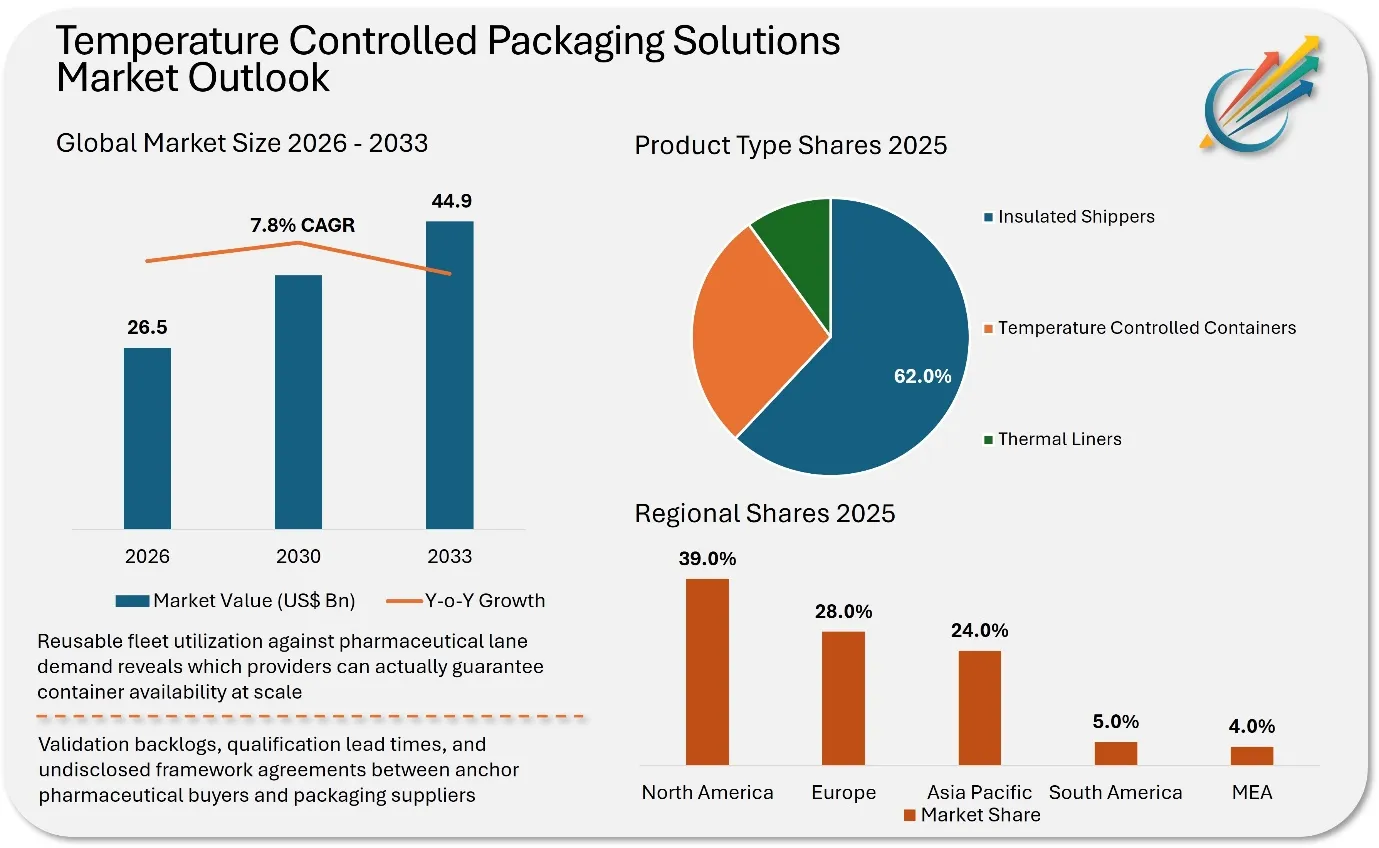
- The temperature controlled packaging solutions market is valued at US$ 26.5 billion in 2026 and is forecasts to reach US$ 44.9 billion by 2033 witnessing a CAGR of 7.8% in between the 2026 to 2033 forecast period.
- Pharmaceutical and biologics shipping remains the largest demand pool by application value across temperature controlled packaging solutions market.
- Reusable container fleets are displacing single-use formats on high-frequency pharmaceutical lanes.
- Vacuum insulated panels and bio-based insulation are gaining share as recyclability mandates tighten.
- Packaging-as-a-service and rental models are reshaping how cold chain capacity is procured in temperature controlled packaging solutions market
As per Vice President from Market Minds Advisory, "Packaging qualification has moved upstream into the product approval pathway, which means thermal decisions now carry regulatory weight that procurement teams underestimate. Companies that lock validated capacity and reusable fleet access over the next four to six quarters will set their excursion economics for the rest of the decade."
A Narrow Strategic Window is Opening for Shippers Still Treating Cold Chain Packaging as a Cost Center
The market window matters now because qualification timelines and capacity commitments are tightening at the same moment demand is accelerating.
- Validation has become a gating constraint: Packaging qualification now feeds directly into biologics licensing evidence. A shipper that cannot demonstrate stability under audit is no longer a procurement question; it can delay a product launch.
- Reusable fleet access is being claimed early: High-volume pharmaceutical shippers are signing multi-year fleet commitments. Available capacity on dense lanes is shrinking faster than most mid-tier buyers have modeled.
- Regulatory recyclability deadlines are firm: European packaging waste rules require full recyclability by 2030. Material transitions take years to qualify, so the work effectively starts now, not at the deadline.
Temperature Controlled Packaging Solutions Market No Longer Defined by Insulation Performance Alone
The most important change in this sector is not a new material. It is a change in ownership logic. Packaging is moving from something a shipper buys and discards to something a shipper accesses, returns, and tracks.
- Pooling models are rewriting the cost base: Reverse logistics and container pooling spread fleet investment across many shippers, converting a capital expense into a per-shipment service cost. This favors providers with dense hub networks and reconditioning capability.
- Data is becoming inseparable from the package: IoT-enabled containers now generate thousands of data points per trip. The package is increasingly a sensing asset, and the telemetry layer is where differentiation, and switching cost, is accumulating.
- Service capability is outweighing product specification: Buyers are selecting on lane coverage, station density, and qualification support rather than insulation specs alone. The temperature controlled packaging solutions market is rewarding integrated operators over component manufacturers.
Assumptions around Cold Chain Packaging Economics and Sustainability Are Breaking Down
A significant share of single-use insulated shipper volume will not survive the decade on pharmaceutical lanes. Reusable economics already win on high-frequency routes, and recyclability mandates remove the regulatory cover that kept disposable formats viable. The defensible question is which lanes flip first, not whether they flip.
Most commentary frames sustainability as a compliance cost. The more decisive effect is competitive sorting. Suppliers without qualified bio-based or recyclable formats will be quietly removed from buyer shortlists well before any deadline, losing access without a formal exit.
The binding constraint over the forecast period is not insulation technology. It is qualified capacity and validation throughput. Demand for biologics shipping is outrunning the industry's ability to validate and field new fleet, and that mismatch, not material science, will shape pricing.
New Competitive Structure Is Forming Across the Temperature Controlled Packaging Solutions Market Ecosystem
Biologics and Advanced Therapy Pipelines
Nearly half of new pharmaceutical approvals require temperature control, and cell and gene therapies push requirements toward frozen and cryogenic set points. Each new modality narrows the field of packaging that can credibly serve it. This concentrates demand on validated, high-performance formats and structurally advantages providers with proven thermal engineering and qualification depth across refrigerated and frozen ranges.
Regulatory Tightening Across Jurisdictions
Good Distribution Practice rules, FDA stability evidence requirements, and European packaging waste regulation are converging into a single message. Packaging must be validated, documented, and increasingly recyclable. Compliance is no longer a regional variable a global shipper can arbitrage. It is a baseline, and meeting it consistently has become a real source of supplier differentiation rather than a checkbox.
The Reusability and Circular Economy Pivot
Corporate ESG commitments and waste regulation are pushing the temperature controlled packaging solutions market toward reusable fleets and reverse logistics. This shift rewards scale and network density, because reconditioning, repositioning, and pooling only work economically with sufficient hub coverage. Smaller players without that footprint face a structural disadvantage that capital alone cannot quickly close.
Digital Telemetry as a Competitive Layer
Real-time monitoring has moved from premium feature to expectation on high-value shipments. Connected containers reduce excursion losses and generate compliance data automatically. The strategic consequence is lock-in. Once a shipper integrates a provider's telemetry into its quality systems, switching costs rise sharply, and the data relationship becomes harder to displace than the hardware.
Ignoring Structural Risks Could Delay Competitive Readiness Across Pharmaceutical Logistics Networks
- Capital intensity of reusable fleets: Container pooling demands heavy upfront investment and reconditioning infrastructure, exposing providers if utilization assumptions prove optimistic.
- Infrastructure gaps in developing regions: Limited cold storage, unreliable power, and weak road networks constrain cold chain reliability across parts of Africa, Latin America, and Asia.
- Raw material and input cost volatility: Polymer and panel input prices fluctuate, compressing margins for manufacturers with limited pricing power.
- Regulatory transition risk: Qualifying bio-based materials takes time, and a delayed transition can strand inventory or trigger extended-producer-responsibility costs.
- Supplier concentration in active containers: A small field of active container providers creates capacity and pricing exposure for pharmaceutical shippers on critical lanes.
- Reverse logistics friction: Empty container returns and repositioning add cost and complexity that can erode the economics of reusable models.
None of these headwinds reverses the directional conclusion. They shape the pace and the margin profile, and they reward operators who plan for them rather than the directional trend itself.
Market Dynamics Shaping the Temperature Controlled Packaging Solutions Market
Temperature Controlled Packaging Solutions Market Segmentation
By Product Type
- Insulated Shippers
- Single-Use Shippers
- Reusable Shippers
- Temperature Controlled Containers
- Passive Containers
- Active Containers
- Thermal Liners
- Box Liners
- Pallet Liners
Insulated shippers anchor parcel-level pharmaceutical and food shipments, but the internal mix is shifting decisively from single-use to reusable formats as frequency-based lanes reward returnable fleets. Temperature controlled containers serve bulk and pallet movements, with active units commanding premium economics on biologics air cargo. Thermal liners remain a pragmatic, lower-cost layer for buyers extending cold chain coverage without redesigning their packaging architecture all over temperature controlled packaging solutions market.
By Packaging Type
- Passive Temperature Controlled Packaging
- Active Temperature Controlled Packaging
- Hybrid Temperature Controlled Packaging
Passive systems dominate by volume, valued for simplicity and the absence of a power source. Active packaging holds disproportionate value on long-duration, high-stakes pharmaceutical lanes where set-point control is non-negotiable. Hybrid configurations are the fastest-evolving tier, blending passive insulation with selective active control to balance reliability against weight and cost. The temperature controlled packaging solutions market increasingly rewards buyers who match packaging type to lane risk rather than standardizing across the board.
By Material Type
- Expanded Polystyrene
- Polyurethane
- Vacuum Insulated Panels
- Paper-Based Insulation
- Reflective Foil Materials
- Bio-Based Insulation Materials
Expanded polystyrene retains a cost advantage but faces regulatory pressure as recyclability mandates advance in temperature controlled packaging solutions market. Vacuum insulated panels deliver superior thermal performance for high-value shipments where space and hold time matter. Paper-based and bio-based insulation are gaining qualified adoption as healthcare logistics providers respond to waste regulation and ESG commitments. Material selection is becoming a forward-looking compliance decision, not a static cost comparison.
By Capacity
- Up To 5 Liters
- 5 To 20 Liters
- 20 To 100 Liters
- Above 100 Liters
Smaller capacities serve clinical trial kits, specialty drugs, and direct-to-patient shipments where shipment value is high and volume per parcel is low. Mid-range formats carry the bulk of routine pharmaceutical and food distribution. Above-100-liter formats align with pallet-scale and air cargo movements, where active containers and pooling economics concentrate. Capacity demand tracks closely with the modality mix moving through a given lane across temperature controlled packaging solutions market.
By Temperature Range
- Frozen Packaging Below -20°C
- Refrigerated Packaging 2°C To 8°C
- Controlled Room Temperature 15°C To 25°C
- Multi-Temperature Packaging
The 2°C to 8°C band remains the workhorse range for vaccines and most biologics in the temperature controlled packaging solutions market. Frozen and ultra-low requirements are expanding fastest, driven by cell and gene therapies that demand cryogenic stability. Controlled room temperature shipments are often underestimated, yet excursions there still compromise efficacy. Multi-temperature packaging is rising as shippers consolidate mixed loads to improve lane efficiency.
By Distribution Channel
- Direct Sales
- Distributors and Wholesalers
- Specialty Stores
- Online Sales
- Third-Party Logistics Providers
- Rental & Leasing Services
Direct sales dominate large pharmaceutical accounts that buy on validation and service depth. Distributors extend reach into fragmented food and regional markets. Third-party logistics providers and rental services are the structurally important channels, because they embody the pivot toward packaging accessed as a service rather than owned outright. The temperature controlled packaging solutions market is increasingly intermediated by operators who bundle hardware, hubs, and data.
By Application
- Pharmaceutical and Biologics Shipping
- Clinical Trials Logistics
- Food and Beverage Transport
- Chemicals Transport
- Agriculture and Horticulture Logistics
- Others
Pharmaceutical and biologics shipping is the highest-value application and the principal driver of premium, validated demand. Clinical trials logistics is smaller but strategically dense, requiring precise control across dispersed sites. Food and beverage transport delivers the largest volume, supported by online grocery growth across temperature controlled packaging solutions market. Chemicals and agriculture applications add steady, less premium demand that broadens the overall base.
Shape this report around your priorities: https://marketmindsadvisory.com/request-customization/?report_id=432
Regional Market Outlook
Investment Focus where the Lucrative Opportunity is Anticipated
Reusable Fleet and Pooling Infrastructure
The strongest defensible positions sit with operators owning reusable container fleets and the hub networks that recondition and reposition them. This is capital-intensive and slow to replicate, which is precisely what makes it durable. Scale here compounds, because utilization improves as network density grows within the temperature controlled packaging solutions market.
Telemetry and Compliance Data Platforms
Connected packaging that generates audit-ready compliance data creates switching costs that hardware alone cannot. Once a shipper embeds a provider's telemetry into its quality systems, the relationship is sticky. Investment in the data and analytics layer captures value that pure manufacturers cannot reach.
Qualified Sustainable Materials
Bio-based, recyclable, and fiber-based insulation that is already qualified for pharmaceutical use is becoming a gating capability. As waste regulation tightens, suppliers holding validated sustainable formats gain shortlist access while competitors scramble. Early qualification, treated as a strategic asset rather than a procurement step, is the defensible move.
Active Containers for Advanced Therapies
The active container niche serving biologics and cell and gene therapies is small in volume but high in value and concentration. Demand is outpacing qualified supply, and the field of credible providers is narrow. Capacity additions and frozen set-point capability represent attractive, structurally advantaged positions.
What This Means for Decision-Makers
Pharmaceutical and Biologics Shippers - Treat packaging qualification as part of the product approval pathway, not a downstream procurement task. Securing validated capacity and reusable fleet access early protects launch timelines and excursion economics that competitors will struggle to match.
Packaging Manufacturers and Suppliers - The temperature controlled packaging solutions market is rewarding integrated service, telemetry, and qualified sustainable materials over component specification. Investment should target reusable fleets, data platforms, and recyclable formats ahead of regulatory deadlines.
Investors - The thesis has matured past technology speculation. Reusable fleet infrastructure, compliance data platforms, and qualified active container capacity offer clearer risk-return profiles than pure material plays in the temperature controlled packaging solutions market.
Third-Party Logistics Providers - Cold chain capability is becoming a differentiator, not an add-on. Building hub density, reverse logistics, and validation support positions providers to capture the shift toward packaging accessed as a managed service.
Competitive Landscape: Temperature Controlled Packaging Solutions Market
Recent Market Developments
- In March 2026, ThermoSafe expanded its reusable temperature-controlled packaging portfolio to support rising demand for biologics and cell and gene therapies.
- In February 2026, Cold Chain Technologies advanced adoption of fiber-based insulated shippers and recyclable PCM-based containers in response to sustainability regulation.
- In January 2026, CSafe Global expanded deployment of IoT-enabled containers integrating real-time tracking for pharmaceutical and biologics shipments.
- In December 2025, Envirotainer continued scaling its active container network to support GDP-compliant biologics air cargo across global pharmaceutical lanes.
Market is segmented by Product Type (Insulated Shippers, Temperature Controlled Containers, Thermal Liners), Packaging Type (Passive, Active, Hybrid), Material Type (Expanded PS, Vacuum Insulated Panels, Bio-Based Insulation), and Application (Pharmaceutical and Biologics Shipping, Clinical Trials Logistics, etc)
Get Access to complete Analysis, Buy Now: https://marketmindsadvisory.com/buy-now/?report_id=432
Trending Reports
- PP Jumbo Bags Market
- PP Closure Market
- Powder Packing Machine Market
- Poultry Packaging Market
- Polywoven Bags Market
- Polyvinyl Chloride (PVC) Packaging Films Market
- Polymer Vials Market
- Plywood Boxes Market
- Plastic Vial Market
- Plastic Tubes Market
Why choose Market Minds Advisory
Market Minds Advisory delivers decision-grade intelligence to executives across machinery, packaging, chemicals, automotive, ICT, food and beverage, consumer goods, and healthcare. We help organizations sharpen market expansion strategies, accelerate share gains, refine brand positioning, and enable account-level growth. Our forecasting integrates primary interviews, proprietary demand models, and continuous market validation, producing the kind of clarity volatile and emerging industries require. Backed by over a decade of sector expertise, our research surfaces white space, opportunity gaps, and competitive blind spots, accounting for recent developments and geopolitical risk. We help businesses see the future of their markets.
Contact Us
Market Minds Advisory
1521 Concord Pike, Suite 301
Wilmington, DE 19803
United States
Email: sales@marketmindsadvisory.com
Website: https://marketmindsadvisory.com/





Comments (0)
Login to join the conversation
Login / RegisterNo comments yet. Be the first to comment!