
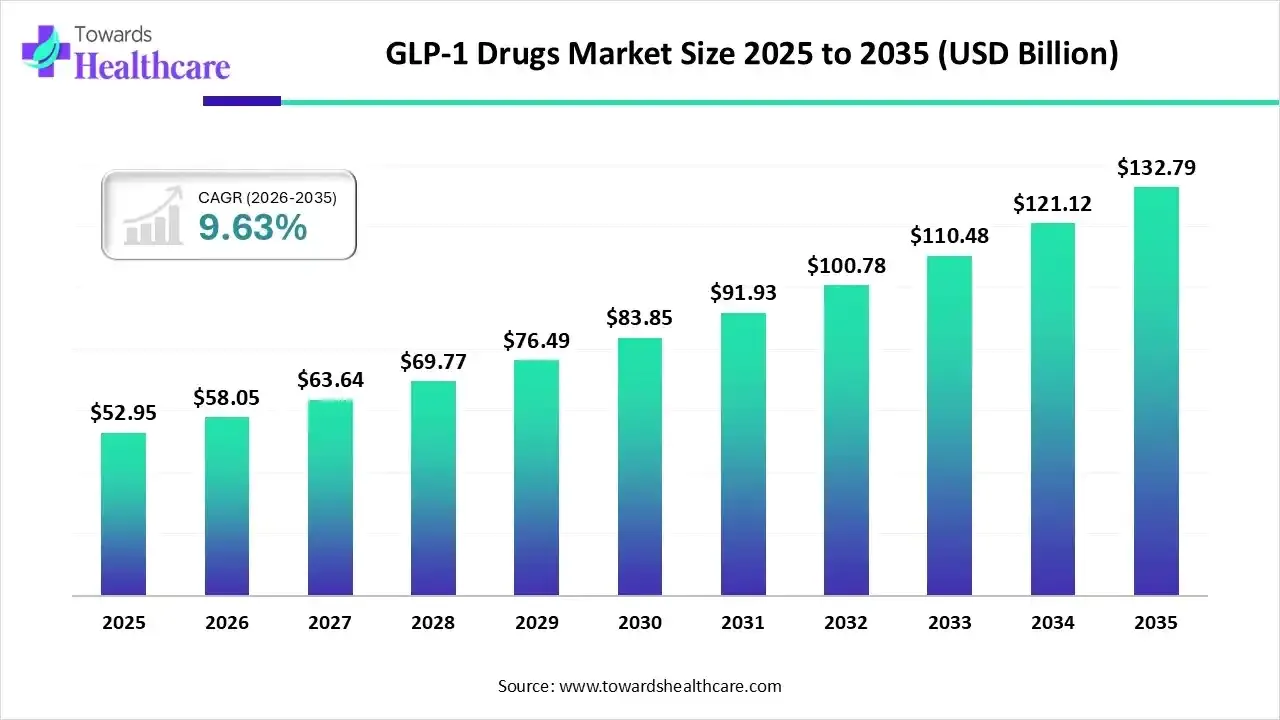
The global GLP-1 drugs market is entering a new phase of expansion as demand shifts beyond traditional diabetes treatment toward obesity management, oral therapies, broader cardiometabolic applications, and next-generation multi-hormone medicines, stated by Towards Healthcare a sister firm of Precedence Research.
Ottawa, Oct. 09, 2026 (GLOBE NEWSWIRE) -- According to Towards Healthcare, the GLP-1 drugs market is projected to increase from USD 52.95 billion in 2025 to USD 58.05 billion in 2026 and USD 132.79 billion by 2035, representing a 9.63% CAGR from 2026 to 2035. North America accounted for 64% of the global market in 2025, while Asia Pacific is projected to be the fastest-growing regional market through 2035.
Download a sample of the GLP-1 Drugs Market report for key insights, market data, and competitive intelligence @ https://www.towardshealthcare.com/download-sample/5878
The competitive landscape is simultaneously changing. Semaglutide accounted for 49% of the market by drug type in 2025, while tirzepatide is projected to be the fastest-growing drug-type segment. Injectable products represented 83% of the market, but oral GLP-1 therapies are expected to record the fastest growth. The shift creates opportunities across drug development, manufacturing, distribution, market access, commercial strategy, competitive intelligence, and supply-chain planning.
Market Data Snapshot
| Metric | Market Data | Business Implication | |
| Global Market Size, 2025 | USD 52.95 Billion | Establishes a large commercial base across diabetes and obesity | |
| Global Market Size, 2026 | USD 58.05 Billion | Represents approximately 9.6% year-on-year expansion | |
| Forecast Market Size, 2035 | USD 132.79 Billion | Creates substantial long-term opportunities for manufacturers and service providers | |
| CAGR, 2026–2035 | 9.63 | % | Supports continued investment in products, capacity, and commercialization |
| North America Share, 2025 | 64 | % | Remains the largest regional opportunity |
| T2D Share, 2025 | 58 | % | Diabetes remains the largest indication base |
| Semaglutide Share, 2025 | 49 | % | Semaglutide remains the leading drug-type segment |
| Injectable Share, 2025 | 83 | % | Injectable therapies currently dominate, while oral products are gaining momentum |
| Retail Pharmacy Share, 2025 | 51 | % | Retail remains the largest channel, but online/DTC is expanding rapidly |
9.63% - Projected CAGR for the global GLP-1 drugs market, 2026–2035
USD 58.05 Bn - Projected global market value in 2026
64% - North America's share of the global market in 2025
83% → Oral Growth
Injectables currently dominate, but oral GLP-1 therapies are positioned for the fastest route-of-administration growth.
Connect with our expert team to discuss your GLP-1 market intelligence requirements and access relevant insights, samples, and solutions @ sales@towardshealthcare.com
What the Latest Data Shows
The market is no longer being defined solely by diabetes treatment. Towards Healthcare identifies Type 2 diabetes as the largest indication, with a 58% share in 2025, but obesity and weight management are expected to be the fastest-growing indication segment. This is changing the commercial profile of GLP-1 medicines from chronic diabetes products into broader metabolic-health platforms.
The transition is already visible in product launches and prescription behavior. Novo Nordisk's Wegovy pill, launched in the U.S. in January 2026, exceeded 3 million prescriptions in just over five months, with more than 80% of new prescriptions coming from people who were new to GLP-1 therapy. This indicates that oral delivery is not simply shifting existing injectable users; it can also expand the addressable treatment population.
The competitive intensity is also increasing around tirzepatide. Eli Lilly reported USD 9.9 billion in worldwide Mounjaro revenue in Q2 2026, up 91% year over year, while U.S. Zepbound revenue reached USD 4.9 billion, up 44%. Mounjaro's international revenue increased 172%, although lower realized prices partially offset volume growth.
What the data indicates: companies competing in GLP-1s increasingly need to track volume, realized pricing, reimbursement, channel mix, patient acquisition, formulation, and geographic expansion together, rather than treating market share as a standalone indicator.
Key Market Trends and Developments
1. Obesity is becoming a major growth engine
The obesity/weight-management segment is expected to grow faster than the broader GLP-1 market as new products, higher doses, oral formulations, and combination therapies expand the treatment landscape. This is also increasing the strategic importance of cardiovascular, metabolic, and other potential applications.
In March 2026, the U.S. FDA approved Wegovy HD, a 7.2 mg semaglutide injection, adding a higher-dose option for chronic weight management. The approval illustrates how manufacturers are extending established molecules through dose optimization while simultaneously investing in new mechanisms.
2. Oral GLP-1s are changing the competitive equation
Oral therapies are expected to be the fastest-growing route of administration. The commercial evidence is already emerging: Wegovy pill crossed three million U.S. prescriptions by June 2026, while newer oral candidates are advancing through clinical development.
Structure Therapeutics reported Phase 2 data for oral aleniglipron showing 16.3% placebo-adjusted mean weight loss at 44 weeks at the 180 mg dose, with Phase 3 initiation targeted for the second half of 2026.
For manufacturers, this creates opportunities around oral formulation technologies, tablet manufacturing, API capacity, packaging, distribution, patient adherence, and differentiated pricing models.
3. Manufacturing capacity is becoming a competitive asset
The scale of investment demonstrates that supply capability is becoming strategically important.
| Company | 2026 Development | Strategic Significance |
| Novo Nordisk | €432 million investment in its Athlone, Ireland facility | Expands capacity for current and future oral GLP-1 products and supports markets outside the U.S. |
| Eli Lilly | More than $3.5 billion planned for a new Pennsylvania injectable medicine and device facility | Supports next-generation weight-loss therapies, including retatrutide |
| Eli Lilly | Additional $4.5 billion committed to expand Indiana manufacturing sites | Strengthens future manufacturing capacity as GLP-1 demand and pipeline depth increase |
For procurement, operations, CDMO, API, device, and supply-chain organizations, monitoring facility locations, production technologies, capacity additions, suppliers, and expansion timelines is becoming as important as tracking clinical pipelines.
4. The next competitive wave is moving beyond single-target GLP-1s
Lilly's retatrutide program is advancing as an investigational GIP/GLP-1/glucagon triple agonist, with the company's Phase 3 clinical package completed for obesity and plans for regulatory submission in 2027. Lilly is also developing eloraTZP, combining tirzepatide with an amylin analogue.
Meanwhile, Zealand Pharma's petrelintide is advancing toward Phase 3 development through its collaboration with Roche, with initiation planned for the second half of 2026.
These developments signal a shift toward multi-hormone mechanisms, differentiated tolerability, oral delivery, longer duration, and improved weight-loss efficacy.
Schedule a meeting with our expert team to discuss your requirements and explore the GLP-1 Drugs Market intelligence in detail @ https://www.towardshealthcare.com/schedule-meeting
Segment & Regional Intelligence
| Segment / Region | Current Position | Growth Signal | Business Opportunity |
| Type 2 Diabetes | 58% share in 2025 | Large established patient base | Commercial optimization, reimbursement and patient-access intelligence |
| Obesity / Weight Management | Fastest-growing indication | Expanding approvals and pipeline | Product launches, market entry, pricing and demand forecasting |
| Semaglutide | 49% share in 2025 | Strong installed base plus oral expansion | Lifecycle management and competitive monitoring |
| Tirzepatide | Fastest-growing drug type | Strong Mounjaro/Zepbound momentum | Competitive positioning and capacity planning |
| Injectable | 83% share in 2025 | Remains dominant | Manufacturing, devices and supply-chain intelligence |
| Oral | Fastest-growing route | Rapid adoption and expanding pipeline | Formulation, commercialization and patient acquisition |
| Retail Pharmacy | 51% share in 2025 | Largest distribution channel | Channel strategy and pharmacy intelligence |
| Online / DTC | Fastest-growing end-user channel | Telehealth and home delivery expansion | Digital GTM, customer intelligence and channel monitoring |
| North America | 64% share in 2025 | Largest market | Scale, competitive intelligence and market-access strategy |
| Asia Pacific | Fastest-growing region | Rising diabetes, obesity and healthcare access | Country prioritization, localization and market entry |
North America remains the commercial center of gravity, but Asia Pacific represents the strongest long-term expansion opportunity. China and India are particularly important for companies evaluating manufacturing, licensing, localization, distribution, and affordability strategies. Europe also remains strategically relevant as reimbursement and access policies evolve.
Company & Competitive Intelligence
The market's competitive structure is increasingly defined by two established leaders, expanding oral competition, and a broad pipeline of next-generation mechanisms.
- Novo Nordisk is extending semaglutide through Wegovy pill and higher-dose Wegovy HD while expanding manufacturing capacity for oral products. Its Q2 2026 data showed continued GLP-1 volume growth across geographies and a 58% GLP-1 volume share.
- Eli Lilly is scaling Mounjaro and Zepbound while investing heavily in manufacturing and advancing retatrutide and oral Foundayo. Its Q2 Mounjaro revenue reached USD 9.9 billion, demonstrating the commercial strength of tirzepatide.
- Structure Therapeutics is positioning oral small-molecule GLP-1 therapy as a potential alternative to injectable medicines, with Phase 2 data supporting continued development.
- Zealand Pharma/Roche are advancing petrelintide toward Phase 3, adding another differentiated approach to obesity treatment.
Regulatory and quality intelligence is also becoming more important. In 2026, U.S. regulatory action targeted non-approved compounded GLP-1 products and proposed excluding semaglutide, tirzepatide, and liraglutide from the 503B bulk-drug list where no clinical need for compounding was identified.
For manufacturers, this means monitoring approved products, compounding activity, API sourcing, regulatory actions, quality risks, and distribution channels is essential to protecting commercial position.
Where the Market Opportunity Is Emerging
The strongest opportunities are increasingly concentrated in areas where clinical innovation intersects with commercial execution:
- Oral GLP-1 platforms that improve convenience and potentially expand treatment uptake.
- Next-generation multi-agonists targeting greater efficacy and differentiated metabolic outcomes.
- Obesity market expansion beyond traditional diabetes-focused commercial models.
- Asia Pacific market entry, particularly in countries with rising diabetes and obesity burdens.
- Manufacturing and capacity intelligence as demand increases and companies build regional supply networks.
- Digital and DTC channels, which are changing how patients discover, access, and refill GLP-1 therapies.
- Pricing and market-access intelligence, particularly as volume growth increasingly interacts with lower realized prices and reimbursement decisions.
- Competitive pipeline monitoring, including oral, dual-agonist, triple-agonist, amylin-combination, and long-acting approaches.
How Towards Healthcare Research Helps Companies in the GLP-1 Drugs Market
Towards Healthcare converts market, company, product, pipeline, manufacturing, customer, and competitive information into decision-ready intelligence for companies operating across the GLP-1 ecosystem.
| Towards Healthcare Solution | What the Client Gets | How It Helps in the GLP-1 Drugs Market |
| Master Dataset | Structured data on companies, products, indications, countries, technologies, facilities, capacity, partnerships, investments, launches, suppliers and competitors | Enables market sizing, competitor tracking, GTM planning, market expansion, sourcing, investment screening and business development |
| Towards Healthcare Quadrant | Company benchmarking, capability comparison, product portfolio assessment and strategic positioning | Helps identify leading competitors, emerging challengers, differentiated portfolios and potential whitespace |
| Interactive Dashboard | Continuously organized indicators covering companies, segments, regions, products, investments, technologies and competitive developments | Allows executives to monitor market movement without repeatedly rebuilding static reports |
| Quality & Manufacturing Intelligence | Facility locations, production capacity, manufacturing developments, suppliers, technologies, expansion plans and operational intelligence | Supports procurement, manufacturing, supply-chain, quality, operations and capacity-planning decisions |
| Customized Research | Market entry, country assessment, customer intelligence, pricing, demand analysis, competitor profiling, technology assessment, M&A and GTM studies | Provides focused answers for launch, investment, partnership, expansion and commercialization decisions |
Master Dataset
A GLP-1-specific intelligence dataset can organize companies, products, drug types, indications, countries, regions, customers, buyers, suppliers, technologies, manufacturing facilities, production capacity, partnerships, investments, product launches, clinical developments, and competitive information.
A pharmaceutical company can use this intelligence to identify white-space markets. A CDMO can map prospective customers and capacity requirements. An investor can benchmark pipelines and manufacturing capabilities. A commercial team can prioritize countries, customer groups, products, and channels.
Towards Healthcare Quadrant
The quadrant framework can compare GLP-1 companies using factors such as portfolio breadth, pipeline strength, product positioning, technology capability, manufacturing footprint, geographic presence, and strategic activity.
This enables management teams to distinguish established leaders from emerging competitors and assess where a company may need stronger capabilities, partnerships, licensing, or acquisition targets.
Interactive Dashboard
Instead of waiting for a new report every time the market changes, clients can use an interactive intelligence environment to monitor market trends, companies, competitors, segments, regions, investments, product developments, technology shifts, manufacturing activity, and other relevant indicators.
This is particularly valuable in GLP-1s because product launches, clinical milestones, regulatory developments, capacity investments, and pricing changes can rapidly alter competitive assumptions.
Quality & Manufacturing Intelligence
For GLP-1 manufacturers and supply-chain organizations, intelligence can cover facility locations, production capacity, API and manufacturing capabilities, production technologies, suppliers, plant expansions, capacity additions, operational developments, and regulatory/compliance signals.
This supports decisions involving supplier selection, manufacturing expansion, sourcing diversification, capacity planning, operational benchmarking, and supply-risk monitoring.
Access the GLP-1 Drugs Market Dashboard for real-time insights, competitive intelligence, market trends, and industry developments: https://www.towardshealthcare.com/access-dashboard
Customized Research
Towards Healthcare can also support focused studies covering:
- GLP-1 market-entry and country prioritization
- Customer and buyer intelligence
- Competitive and company profiling
- Product and pipeline intelligence
- Technology assessment
- Demand and opportunity mapping
- Pricing and reimbursement analysis
- Supplier intelligence
- Strategic benchmarking
- M&A and investment intelligence
- GTM and commercialization strategy
- Manufacturing and capacity assessment
Continuously Updated Market Intelligence
GLP-1 intelligence can be maintained according to business requirements through monthly, quarterly, six-monthly, or annual updates.
For a fast-moving GLP-1 portfolio, monthly updates can capture new competitors, product launches, clinical milestones, investments, capacity expansions, partnerships, pricing changes, regulatory developments, technology advances, and customer developments.
Quarterly updates can support management reviews and competitive planning, while six-monthly or annual updates can support strategic planning, market-entry decisions, investment assessments, and long-range portfolio strategy.
The objective is to keep market intelligence aligned with the speed at which the GLP-1 industry is changing.
Fill out the form for relevant samples, case studies, and examples: https://www.towardshealthcare.com/contact-us
Conclusion
The GLP-1 drugs market is moving from a diabetes-centered category toward a broader metabolic-health industry shaped by obesity treatment, oral delivery, next-generation multi-agonists, manufacturing expansion, digital channels, regulatory changes, and increasingly sophisticated competition. With the market projected to reach USD 132.79 billion by 2035 at a 9.63% CAGR, companies that can connect market demand with product, competitive, manufacturing, pricing, and geographic intelligence will be better positioned to identify opportunities and manage risk.
Towards Healthcare provides market-specific intelligence designed to help pharmaceutical, biotech, medtech, CDMO, investment, and healthcare organizations make informed decisions across the GLP-1 value chain.
Buy the GLP-1 Drugs Market report directly to access comprehensive market data, forecasts, competitive intelligence, and strategic insights @ https://www.towardshealthcare.com/checkout/5878
Related Reports:
GLP-1 Small Molecule Market Size, Insights and Growth with Key Players
The GLP-1 small molecule market is rapidly advancing on a scale, with expectations of accumulating hundreds of millions in revenue between 2026 and 2035. Market forecasts suggest robust development fueled by increased investments, innovation, and rising demand across various industries.
GLP-1 Receptor Agonist Market Trends for 2026
The global GLP-1 receptor agonist market size was calculated at USD 62.86 billion in 2025, grew to USD 73.86 billion in 2026, and is projected to reach around USD 315.33 billion by 2035. The market is expanding at a CAGR of 17.5% between 2026 and 2035.
Oral GLP-1 Market Trends for 2026
The oral GLP-1 market size in 2025 was US$ 6.81 billion, expected to grow to US$ 9.19 billion in 2026 and further to US$ 137.36 billion by 2035, backed by a robust CAGR of 35.05% between 2026 and 2035.
About Us
Towards Healthcare Research & Consulting is a leading global provider of technological solutions, clinical research services, and advanced analytics, with a strong emphasis on life science research. Dedicated to advancing innovation in the life sciences sector, we build strategic partnerships that generate actionable insights and transformative breakthroughs. As a global strategy consulting firm, we empower life science leaders to gain a competitive edge, drive research excellence, and accelerate sustainable growth.
You can place an order or ask any questions, please feel free to contact us at sales@towardshealthcare.com
Europe Region: +44 778 256 0738
North America Region: +1 8044 4193 44
APAC Region: +91 9356 9282 04
Our Trusted Data Partners



Comments (0)
Login to join the conversation
Login / RegisterNo comments yet. Be the first to comment!