
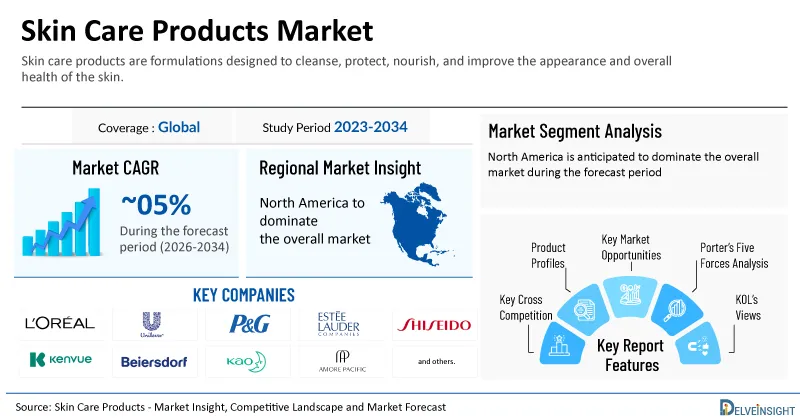
The skin care products market is experiencing steady growth, driven by rising consumer awareness of skin health, increasing disposable incomes, and growing emphasis on personal grooming and preventive skincare. Demand is shifting from basic products toward premium, ingredient-focused, and dermatologist-recommended formulations, including serums, sunscreens, moisturizers, and anti-aging solutions. The growing preference for clean, natural, vegan, and science-backed products is further encouraging manufacturers to invest in innovative formulations and transparent ingredient labeling.
New York, USA, Sept. 02, 2026 (GLOBE NEWSWIRE) -- Global Skin Care Products Market is Expected to Surpass the USD 260 Billion Mark by 2034 | DelveInsight
The skin care products market is experiencing steady growth, driven by rising consumer awareness of skin health, increasing disposable incomes, and growing emphasis on personal grooming and preventive skincare. Demand is shifting from basic products toward premium, ingredient-focused, and dermatologist-recommended formulations, including serums, sunscreens, moisturizers, and anti-aging solutions. The growing preference for clean, natural, vegan, and science-backed products is further encouraging manufacturers to invest in innovative formulations and transparent ingredient labeling.
DelveInsight’s Skin Care Products Market Insights report provides the current and forecast market analysis, individual leading skin care products companies’ market shares, challenges, skin care products market drivers, barriers, trends, and key skin care products companies in the market.
Skin Care Products Market Summary
- 2025 Skin Care Products Market Size: ~USD 166 Billion
- 2034 Projected Skin Care Products Market Size: ~USD 262 Billion
- Skin Care Products Market Growth Rate (2026-2034): ~5%
- Largest Skin Care Products Market: Asia-Pacific
- Largest Product Formulation Segment: Creams & Lotions Category
- Key Companies in the Skin Care Products Market: L'Oréal S.A., Unilever PLC, The Procter & Gamble Company, The Estée Lauder Companies Inc., Shiseido Company, Limited, Kenvue Inc., Beiersdorf AG, Kao Corporation, Amorepacific Corporation, Colgate-Palmolive Company, and others
To read more about the strategies to implement skin care products, get a snapshot @ https://www.delveinsight.com/report-store/skin-care-products-market
Key Factors Contributing to the Rise in Growth of the Skin Care Products Market
- Rising Consumer Awareness of Skin Health: Growing awareness of the importance of maintaining healthy skin is encouraging consumers to adopt regular skincare routines. Increased access to information through social media, beauty platforms, and dermatologists is also driving demand for specialized skincare products.
- Growing Demand for Anti-Aging Products: Rising interest in maintaining youthful-looking skin is boosting demand for anti-aging creams, serums, moisturizers, and other targeted formulations. Consumers are increasingly seeking products containing ingredients such as retinol, peptides, hyaluronic acid, and antioxidants.
- Expansion of Premium and Personalized Skincare: Consumers are increasingly willing to spend on premium products offering advanced formulations and targeted benefits. Personalized skincare solutions based on skin type, concerns, and individual needs are further supporting market expansion.
- Influence of Social Media and Beauty Trends: Social media platforms, beauty influencers, and online reviews play a major role in shaping consumer preferences and accelerating product discovery. Viral skincare trends and educational content are encouraging consumers to experiment with new products and routines.
- Growing Preference for Natural and Clean-Label Products: Increasing consumer focus on ingredient safety and sustainability is driving demand for natural, organic, vegan, and clean-label skincare products. Brands are responding by developing formulations with plant-based ingredients and transparent ingredient labeling.
- Expansion of E-Commerce and Digital Retail: The rapid growth of e-commerce has improved access to a wide range of domestic and international skincare brands. Online platforms also provide product reviews, personalized recommendations, promotional offers, and convenient home delivery, encouraging purchases.
- Increasing Male Grooming and Skincare Adoption: Growing awareness of personal appearance and grooming among men is expanding the customer base for skincare products. Demand is increasing for facial cleansers, moisturizers, sunscreens, anti-aging products, and products specifically formulated for men's skin.
- Growing Demand for Dermatologically Tested Products: Consumers are increasingly seeking clinically tested and dermatologist-recommended products, particularly for sensitive skin, acne, pigmentation, and other skin concerns. This trend is strengthening demand for dermocosmetic and science-backed skincare formulations.
- Product Innovation and Advanced Formulations: Continuous innovation in active ingredients, delivery systems, multifunctional products, and targeted formulations is supporting market growth. Brands are introducing products that combine benefits such as hydration, sun protection, anti-aging, brightening, and skin barrier repair.
Get a sneak peek at the skin care products market dynamics @ Skin Care Products Market Trends
Regional Skin Care Products Market Insights
Asia-Pacific
- Asia-Pacific generated 38% of global skincare products market revenue in 2025, securing the largest regional share worldwide.
- This leading position is supported by strong cultural traditions surrounding skincare in countries such as China, Japan, and South Korea, along with rapid urbanization, increasing disposable incomes, and the worldwide popularity of K-beauty and J-beauty trends.
- The region has some of the most advanced multi-step skincare consumer markets, with established local players such as Amorepacific and Kao competing with international brands across both mass-market and premium segments.
- Growing consumer interest in brightening, hydrating, and anti-pollution products, together with the rapid expansion of e-commerce and livestream shopping in China, continues to drive significant market growth.
- Ongoing urbanization, the expansion of the middle-class population, and increasing premiumization in India and Southeast Asia are expected to reinforce Asia-Pacific's market leadership throughout the forecast period.
North America
- North America is projected to be the fastest-growing region in the skincare products market, supported by a strong consumer shift toward dermaceuticals and clinically proven, dermatologist-recommended formulations.
- Growth is further fueled by the increasing adoption of AI-driven personalized skincare solutions and rising consumer preference for clean-label and hydration-focused products.
- The United States remains the primary growth engine, benefiting from a well-established retail and e-commerce ecosystem, a strong presence of leading derma-cosmetic brands such as CeraVe, Cetaphil, and Neutrogena, and growing interest in men’s grooming products.
- Increasing consumer spending on premium, science-backed skincare, along with the expansion of digital-first brands and direct-to-consumer business models, is expected to make North America a key contributor to incremental market growth throughout the forecast period.
Europe
- Europe represents a mature and highly developed market for skin care products, supported by strong consumer awareness, established beauty brands, advanced retail infrastructure, and growing demand for products that combine cosmetic benefits with proven dermatological efficacy.
- Demand is increasingly shifting toward clean-label, natural and organic formulations, multifunctional products, anti-aging solutions, sunscreens, and science-backed dermocosmetics, as consumers place greater emphasis on ingredient transparency, product safety, and clinically demonstrated results.
- At the same time, e-commerce is gaining importance alongside pharmacies, drugstores, specialty beauty retailers, and supermarkets, while younger consumers are accelerating demand for sustainable, inclusive, personalized, and digitally accessible skincare solutions.
To know more about why APAC is leading the market growth in the skin care products market, get a snapshot of the Skin Care Products Market Share
Recent Developmental Activities in the Skin Care Products Market
- In June 2026, L'Oréal S.A. signed an agreement to acquire a majority stake in Innovist, a leading house of personal care brands in India, expanding its reach across the fast-growing Indian skincare market.
- In March 2026, Kenvue Inc. (Neutrogena, Aveeno, and Rogaine) debuted 20 new research abstracts and clinical skincare innovations at the American Academy of Dermatology Annual Meeting in Denver.
- In 2026, Beiersdorf AG launched a EUR 100 million venture fund to back early-stage skincare innovation, alongside plans to restore momentum to its flagship Nivea brand.
- In 2026, the Estée Lauder Companies Inc. acquired the remaining 51% stake in Indian heritage skincare brand Forest Essentials, building on its existing investment in the company.
- In Q1 2026, Kenvue Inc. reported Skin Health and Beauty net sales growth of 8.4%, driven by Neutrogena's expansion into sun care across select EMEA markets and e-commerce acceleration, ahead of a proposed transaction involving Kimberly-Clark.
What is Skin Care Products?
Skin care products are formulations designed to cleanse, protect, nourish, and improve the appearance and overall health of the skin. They include a wide range of products such as cleansers, moisturizers, toners, serums, exfoliants, sunscreens, masks, and specialized treatments for concerns such as acne, dryness, pigmentation, aging, and sensitivity. Depending on their ingredients and intended use, skin care products may help maintain skin hydration, support the skin barrier, protect against environmental factors such as ultraviolet (UV) radiation and pollution, and address specific dermatological concerns. The growing consumer focus on personal grooming, preventive skin health, and aesthetic appearance has further expanded the demand for diverse and specialized skin care products.
| Skin Care Products Market Report Metrics | Details |
| Coverage | Global |
| Study Period | 2023–2034 |
| Skin Care Products Market CAGR | ~5% |
| Skin Care Products Market Size by 2034 | ~USD 262 Billion |
| Key Skin Care Products Companies | L'Oréal S.A., Unilever PLC, The Procter & Gamble Company, The Estée Lauder Companies Inc., Shiseido Company, Limited, Kenvue Inc., Beiersdorf AG, Kao Corporation, Amorepacific Corporation, Colgate-Palmolive Company, and others |
Skin Care Products Market Assessment
- Skin Care Products Market Segmentation
- Skin Care Products Market Segmentation By Product Type: Cleansers & Face Washes, Moisturizers & Creams, Serums & Essences, Sunscreens & Sun Protection, Exfoliators & Scrubs, Others
- Skin Care Products Market Segmentation By Product Formulation: Creams & Lotions, Gels, Serums, Oils, Balms, Others
- Skin Care Products Market Segmentation By Skin Concerns: Acne & Blemishes, Dryness & Dehydration, Hyperpigmentation & Dark Spots, Wrinkles & Fine Lines, Others
- Skin Care Products Market Segmentation By Skin Concerns: Normal, Dry, Oily, Combination, Sensitive
- Skin Care Products Market Segmentation By Consumer Age Group: Infants & Children, Teenagers, Adults
- Skin Care Products Market Segmentation By Distribution Channel: Online/E-Commerce, Supermarkets & Hypermarkets, Pharmacies & Drugstores, Others
- Skin Care Products Market Segmentation By Geography: North America, Europe, Asia-Pacific, and Rest of World
- Porter’s Five Forces Analysis, Product Profiles, Case Studies, KOL’s Views, Analyst’s View
Which MedTech key players in the skin care products market are set to emerge as the trendsetter explore @ Skin Care Products Market Analysis
Table of Contents
| 1 | Skin Care Products Market Report Introduction |
| 2 | Skin Care Products Market Executive Summary |
| 3 | Skin Care Products Market Key Factors Analysis |
| 4 | Impact Analysis |
| 5 | Regulatory Analysis |
| 6 | Skin Care Products Market Porter’s Five Forces Analysis |
| 7 | Skin Care Products Market Assessment |
| 8 | Competitive Landscape |
| 9 | Startup Funding & Investment Trends |
| 10 | Skin Care Products Market Company and Product Profiles |
| 11 | KOL Views |
| 12 | Project Approach |
| 13 | About DelveInsight |
| 14 | Disclaimer & Contact Us |
Interested in knowing the skin care products market share by 2034? Click to get a snapshot of the Top Skin Care Products
Related Reports
Skin Care Supplements Market Insights, Competitive Landscape, and Market Forecast – 2034 report deliver an in-depth understanding of the market trends, market drivers, market barriers, and key skin care supplements companies, including Amway, Nestlé Health Science, HUM Nutrition, Herbalife Nutrition, Meiji Holdings, Unilever (OLLY), Shiseido, Blackmores, Swisse Wellness, Vitabiotics, Perricone MD, GNC Holdings, The Clorox Company (NeoCell), Nature’s Bounty, The Beauty Chef., and others.
Anti-Aging Products Market Insight, Competitive Landscape, and Market Forecast – 2034 report delivers an in-depth understanding of market trends, market drivers, market barriers, and key anti-aging products companies such as Procter & Gamble Co., Johnson & Johnson, Unilever plc, L’Oréal Groupe, Beiersdorf, CeraVe, JNTL Consumer Health (India) Private Limited, RoC Skincare, La Roche-Posay, No7 Beauty Company, REN Clean Skincare, GALDERMA, Clinique Laboratories, LLC., Shiseido Company, The Estée Lauder Companies, Life Extension, Vichy Laboratoires, Kiehl’s Since 1851, Groupe Clarins, Origins Natural Resources, Inc., and others.
Anti-Aging Ingredients Market Insights, Competitive Landscape, and Market Forecast – 2034 report deliver an in-depth understanding of the market trends, market drivers, market barriers, and key anti-aging ingredients companies, including ADEKA CORPORATION, Contipro a.s., Beiersdorf AG, BioThrive Sciences, Kao Corporation, Shiseido Co., Ltd., BASF Personal Care and Nutrition GmbH, Dow, Croda International Plc, Wacker Chemie AG, Lonza, Estée Lauder Inc., DSM, Merck KGaA, Ashland, Symrise, Solvay, Evonik Industries AG, Lubrizol Corporation, TER INGREDIENTS GMBH & CO. KG, and others.
Acne Market Insights, Epidemiology, and Market Forecast – 2036 report deliver an in-depth understanding of the disease, historical and forecasted epidemiology, as well as the market trends, market drivers, market barriers, and key acne companies including Galderma S.A., Johnson & Johnson, Bausch Health Companies Inc., AbbVie Inc. (Allergan), Sun Pharmaceutical Industries Ltd., Almirall S.A., Pfizer Inc., Bayer AG, Teva Pharmaceutical Industries Ltd., Viatris Inc., LEO Pharma A/S, GlaxoSmithKline plc, and others.
Acne Pipeline Insight – 2026 report provides comprehensive insights about the pipeline landscape, pipeline drug profiles, including clinical and non-clinical stage products, and the key acne companies, including Galderma S.A., Johnson & Johnson, Bausch Health Companies Inc., AbbVie Inc. (Allergan), Sun Pharmaceutical Industries Ltd., Almirall S.A., Pfizer Inc., Bayer AG, Teva Pharmaceutical Industries Ltd., Viatris Inc., LEO Pharma A/S, GlaxoSmithKline plc, and others.
About DelveInsight
DelveInsight is a leading Business Consultant and Market Research firm focused exclusively on life sciences. It supports pharma companies by providing comprehensive end-to-end solutions to improve their performance. Get hassle-free access to all the healthcare and pharma market research reports through our subscription-based platform PharmDelve.
CONTACT: Contact Us

Shruti Thakur

info@delveinsight.com

+14699457679





Comments (0)
Login to join the conversation
Login / RegisterNo comments yet. Be the first to comment!