
U.S. Low Power Next Generation Display Market to Reach USD 77.49 Million by 2035 as North America Holds 36.0% Share and Asia Pacific Records the Fastest Growth at 8.2% CAGR
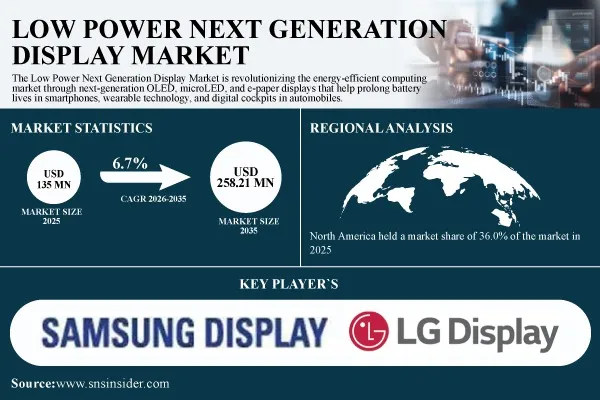
Austin, Sept. 16, 2026 (GLOBE NEWSWIRE) -- According to SNS Insider, the Low Power Next Generation Display Market was valued at USD 135 Million in 2025 and is projected to reach USD 258.21 Million by 2035, registering a CAGR of 6.7% from 2026 to 2035. Growth of the market is being boosted by increased implementation of energy-efficient OLED, microLED, and e-paper technologies in smartphones, wearables, automotive digital cockpits, and connected devices. Increasing implementation of dynamic LTPO OLED displays, energy-efficient microdisplays used in AR/VR, and high-end tandem OLED technology is aiding manufacturers in cutting down power consumption, as well as enhancing display brightness, quality, and performance.
In 2025, Samsung Display launched its QD-OLED Penta Tandem technology which is composed of five organic layers, aiming to provide high levels of peak brightness and increased operational lifetime. The Planar Systems also formed a partnership with Megapixel in 2025 to create an advanced generation of LED display system that integrates the visualization technology of Planar with advanced processing systems.
Download the Low Power Next Generation Display Market Sample Report: https://www.snsinsider.com/sample-request/10998
Low Power Next Generation Display Market Key Highlights
- Market size, 2025: USD 135 Million
- Market forecast, 2035: USD 258.21 Million
- CAGR: 6.7% from 2026 to 2035
- Largest region: North America, with 36.0% share in 2025
- Fastest-growing region: Asia Pacific, at 8.2% CAGR from 2026 to 2035
- Largest technology: OLED, with 41% share in 2025
- Fastest-growing technology: MicroLED
- Largest panel size: Small Panels (2"–7"), with 34% share in 2025
- Fastest-growing panel size: Microdisplays (<2")
- Largest form factor: Rigid Displays, with 52% share in 2025
- Fastest-growing form factor: Foldable Displays
- Largest application: Consumer Electronics, with 48% share in 2025
- Fastest-growing application: AR/VR/XR Devices
Market Relevance
Next generation low power display technologies are becoming more relevant with time as modern electronics, such as consumer electronics, wearables, automotive and IoT require better display quality without consuming more energy. Displays impact the battery life, thermal characteristics, weight and energy efficiency of the product. As a result, display technologies including LTPO OLED, microLED, tandem OLED and microdisplays are becoming more important for manufacturers because of their need to make displays brighter, faster and sharper without violating energy efficiency standards.
Low Power Next Generation Display Market Overview
The Low Power Next Generation Display Market encompasses OLED, microLED, e-paper, quantum dot, and several more innovative displays that have been created in order to decrease power consumption for portable, automotive, industrial, and immersive devices. The OLED technology continues to be the largest segment because of its self-emission design, high brightness and contrast, and capacity for adaptive refresh rate.
Strategic Market Outlook
Foldable OLED technology has potential value given the rising incorporation of adaptive refresh rate technology into the design of flexible displays by device companies. The technology will help increase battery efficiency while being able to design thinner devices. With the increasing adoption of foldable smartphones and tablets, display companies with reliable foldable OLED technology can capture more market share.
Low Power Next Generation Display Market Regional Analysis
The North American region dominated the market with a market share of 36.0%, aided by robust consumer electronics demand, high-level research and development capabilities, and rising adoption of OLED, microLED, and quantum dot technology in smartphones, smart TVs, automobile displays, wearables, and AR/VR applications. Regional demand has also been fueled by investments in automotive digital display applications and dynamic display control systems through IoT technologies. The U.S. Low Power Next Generation Display Market is estimated to be around USD 42.44 Million in 2025 and forecasted to reach around USD 77.49 Million by 2035, growing at a CAGR of around 6.2% during the period 2026 to 2035.
The Asia Pacific region is witnessing the highest growth rate and is expected to achieve a CAGR of 8.2% during 2026-2035. The region benefits from its robust ecosystem for OLEDs, microLEDs, and quantum dots manufacture in China, Japan, South Korea, and Taiwan. In 2025, China contributed about 40.00% to the total Asia Pacific revenues due to its large panel makers and capacity increases of low power displays.
Buy the Low Power Next Generation Display Market Report with Competitive Analysis and 2035 Forecast: https://www.snsinsider.com/checkout/10998
Low Power Next Generation Display Market Segment Analysis
By Technology: OLED had a huge 41% market share in 2025 caused by its self-emissive nature, high brightness, high efficiency, and use in smartphones, tablets, automotive displays, and premium electronics. MicroLED is the most rapidly growing technology owing to the developments in mass transfer, defect handling, high brightness, and high yield.
By Panel Size: Small Panels (2" – 7") led the segment with 34%, thanks to widespread adoption in smartphones, tablets, and wearables. These panels' capability to utilize LTPO OLED and energy-saving LCD display technology plays an important role in improving battery performance and enabling the always-on feature. Microdisplays (<2") continue to be the most rapidly growing segment due to their need in AR/VR headsets and smart glasses.
By Form Factor: The Rigid Displays form factor accounted for 52% of total units shipped in 2025 due to its well-established manufacturing technologies and process reliability, low cost, and wide-scale applications in consumer electronics. The Foldable Displays form factor is the most rapidly developing one since smartphone and tablet vendors continue investing in flexible panels with adaptive refresh rate capability.
By Application: In 2025, Consumer Electronics accounted for 48% of market share due to its extensive use in smartphones, tablets, laptops, wearables, and other mobile devices where efficient use of batteries is essential. The AR/VR/XR Devices segment is the fastest growing end-use segment because such systems require energy-efficient and compact microdisplays.
Low Power Next Generation Display Market Key Trends
- Rapid adoption of LTPO OLED panels continues enabling dynamic refresh rates that reduce smartphone power consumption.
- Growing commercialization of mass transfer and hybrid bonding techniques continues improving microLED yield and cost efficiency.
- Rising integration of display hardware with power-management ICs continues optimizing system-level energy efficiency in portable electronics.
- Increasing adoption of tandem and multi-stack OLED architectures continues improving brightness while reducing per-unit power draw.
- Expanding digital automotive cockpit deployment continues driving demand for energy-efficient, high-resolution in-vehicle display systems.
Competitive Landscape
The Low Power Next Generation Display Market includes global panel manufacturers, OLED material specialists, microLED developers, consumer electronics companies, display processing providers, and advanced materials suppliers competing across smartphones, automotive displays, AR/VR, wearables, televisions, digital signage, and industrial applications. Competitive differentiation increasingly centers on energy efficiency, brightness, panel lifetime, manufacturing yield, form-factor flexibility, adaptive refresh performance, and scalability of advanced display production.
In 2025, Samsung Display introduced its QD-OLED Penta Tandem panel technology for monitors and televisions, featuring a five-layer organic structure designed to provide higher peak brightness and longer operating life. In 2025, Panasonic Projector & Display Corporation launched a new sub-brand focused on advanced visual solutions for professional and entertainment applications. In 2025, Planar Systems announced a strategic partnership with Megapixel to develop a premium next-generation LED display platform combining visualization technology with advanced processing for ultra-fine pixel-pitch video walls.
Major key players include
Samsung Display, BOE Technology Group, LG Display, AU Optronics Corporation, Visionox Technology, Panasonic Corporation, Sharp Corporation, Sony Corporation, Tianma, Universal Display Corporation (UDC), QUALCOMM Incorporated, Nanosys, Planar Systems, Novaled GmbH, Koninklijke Philips N.V., DuPont de Nemours, Inc., Futaba Corporation, RiTdisplay Corporation, Innolux Corporation, E Ink Holdings Inc.
Explore the Complete Low Power Next Generation Display Market Report: https://www.snsinsider.com/reports/low-power-next-generation-display-market-10998
About Us:
SNS Insider is one of the leading market research and consulting agencies that dominates the market research industry globally. Our company's aim is to give clients the knowledge they require in order to function in changing circumstances. In order to give you current, accurate market data, consumer insights, and opinions so that you can make decisions with confidence, we employ a variety of techniques, including surveys, video talks, and focus groups around the world.
CONTACT: Contact Us:
Rohan Jadhav - Principal Consultant
Phone: +1-315-961-9094 (US)








Comments (0)
Login to join the conversation
Login / RegisterNo comments yet. Be the first to comment!