
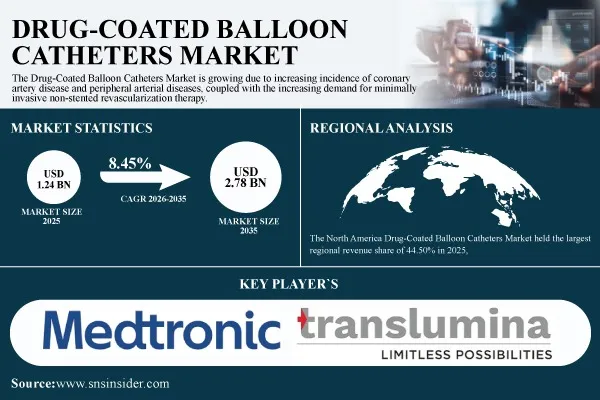
SNS Insider projects the Global Drug-Coated Balloon Catheters Market is projected to reach USD 2.78 billion by 2035, growing at a 8.45% CAGR, while the U.S. market is projected to reach USD 1,022.10 million, advancing at 8.30% CAGR, as next-generation drug coatings and minimally invasive vascular interventions expand catheterization adoption.
Austin, Texas, Sept. 22, 2026 (GLOBE NEWSWIRE) -- The global Drug-Coated Balloon Catheters Market was valued at USD 1.24 billion in 2025 and is projected to reach USD 2.78 billion by 2035, expanding at a CAGR of 8.45% during 2026–2035. Demand is getting a boost from the increased prevalence of coronary artery disease and peripheral arterial disease, along with the growing adoption of minimally invasive and non-stented revascularization techniques. Drug-coated balloons offer local delivery of antiproliferative agents without any permanent implants and hence, find application in in-stent restenosis, femoral-popliteal lesions, and complex vascular reconstructions.
Download the Drug-Coated Balloon Catheters Market Sample Report: https://www.snsinsider.com/sample-request/11107
The U.S. Drug-Coated Balloon Catheters Market was valued at approximately USD 498.60 million in 2025 and is projected to reach approximately USD 1,022.10 million by 2035, growing at a CAGR of approximately 8.30% during 2026–2035. The growth in market is driven by the high prevalence of cardiovascular diseases, existing lab for catheterization setup, increasing use of paclitaxel and sirolimus coated balloons, development of outpatient catheterization labs, active patient registries, and the clinical trials being conducted on DCBs.
Europe Drug-Coated Balloon Catheters Market was valued at USD 0.335 billion in 2025 and is projected to reach USD 0.730 billion by 2035, expanding at a CAGR of 8.10% during 2026–2035. The Europe Drug-Coated Balloon Catheters Market still constitutes an important share of the total global demand, driven by the presence of a well-established interventional cardiology ecosystem, significant disease prevalence, and high medical professional experience in the use of the DCB therapy approach.
Why this Market is Gaining Attention in 2026
Stent-Free Revascularization is Expanding the Role of Drug-Coated Balloons
Drug-coated balloon catheter products are becoming part of the move toward “leave nothing behind” treatments for vascular disease. Instead of putting stents into the vessel that remain inside permanently, the DCB deposits an antiproliferative agent onto the vessel wall. Thus, the technology is applicable for situations including in-stent restenosis, PAD, and some complex coronary artery disease cases.
There is increasing interest by physicians in minimally invasive approaches to treatment that do not leave anything behind, which is leading to increasing use of the technology. There are particular cases of long and mobile peripheral arteries where there are risks of fracture and restenosis.
Sirolimus-Based Coatings are Creating a New Technology Opportunity
The market is witnessing increasing development of sirolimus-coated balloon platforms, along with existing paclitaxel-coated products. Sirolimus-coated platforms are being developed to enhance drug retention, prolonged release, and maintenance of vessel patency, thus widening the technology space for DCB manufacturers.
Further innovations in coating, drug loading, and delivery systems would increase the utility of DCBs in a clinical setting. Regulatory clearance and clinical data are assisting manufacturers in bringing their next generation of platforms to the market.
AI-Assisted Imaging and Outpatient Procedures Expand the DCB Opportunity
Drug-coated balloon treatment is also reaping the benefits of improvements in intravascular imaging, as well as the shift of some endovascular procedures to the outpatient setting. AI-based imaging solutions, which include systems that support the work of both IVUS and OCT, could help with lesion evaluation and increase procedure accuracy during vascular procedures.
At the same time, the growth of catheterization capacities at ambulatory surgery centers creates more options for performing low-risk peripheral procedures. Faster recovery and changes in reimbursement options have enabled the transfer of selected DCB treatments to the outpatient setting.
Commercial Findings from the Drug-Coated Balloon Catheters Market
Peripheral DCB Dominated and Coronary DCB is the Fastest-Growing Type: Peripheral DCB was the major contributor to the market by type, constituting around 71.40% share in 2025, owing to high demand for peripheral artery disease management, especially femoropopliteal and below-the-knee lesions. The coronary DCB segment is expected to be the highest-growing type segment, growing at a CAGR of about 9.65% during 2026-2035, owing to rising adoption for coronary in-stent restenosis and
Hospitals Dominated and Ambulatory Surgical Centers are the Fastest-Growing End Use: In 2025, Hospitals had the largest share of the market for Drug-Coated Balloon Catheters Market at 68.30%, owing to their highly developed catheterization laboratories, advanced imaging systems, and access to multi-disciplinary teams of cardiologists. The fastest CAGR of approximately 10.15% for Ambulatory Surgical Centers will be observed during 2026–2035 due to increased use of peripheral vascular procedures.
Regional Cardiovascular Investment is Reshaping DCB Demand: The North American region captured about 44.50% of the global Drug Coated Balloon Catheters Market in 2025 owing to presence of advanced cardiovascular care facilities, clinical trials and reimbursement. The Asia-Pacific region is anticipated to witness the highest CAGR of about 10.20% during 2026-2035 due to increasing prevalence of heart diseases, growing catheterization laboratories and growing government spending on cardiac care.
Download Sample Report: https://www.snsinsider.com/sample-request/11107
Who Should be Watching the Drug-Coated Balloon Catheters Market?
The market is increasingly relevant across the broader cardiovascular and endovascular treatment ecosystem, including:
Medical device manufacturers → interventional cardiology companies → vascular device developers → hospitals → catheterization laboratories → ambulatory surgical centers → specialty cardiac centers → vascular surgeons → interventional cardiologists → healthcare providers
Medical device companies have been able to look at new possibilities outside their current offering of balloon angioplasty treatments. Positioning is contingent on the use of advanced coating technology, long-term drug release, procedure reliability, regulatory clearance, clinical proof and an approach to coronary and peripheral applications. In the case of hospitals and healthcare practitioners, coated balloons offer another minimally invasive treatment for restenosis and vascular diseases without any implanted device.
Strategic Partnerships, Regulatory Approvals and Product Commercialization Shape the 2026 Market
As clinical adoption increases, manufacturers are expanding their drug-coated balloon portfolios through acquisitions, regulatory approvals and commercialization partnerships across major cardiovascular markets.
- In 2025, Teleflex Incorporated completed its acquisition of BIOTRONIK’s Vascular Intervention business, including the Pantera Lux drug-coated balloon, for an estimated cash payment of approximately EUR 760 million, expanding its coronary and peripheral catheter-based therapy portfolio.
- In 2025, BrosMed and Cordis entered a strategic collaboration to commercialize the VaSecure next-generation drug-coated balloon across China, supporting wider distribution and clinical adoption.
Market Challenge: Managing Device Costs, Procedural Risks and Regulatory Requirements
The introduction of the coated balloon catheters is still constrained by high costs relative to regular uncoated balloons, special equipment for the procedure and training of interventional specialists. These constraints may hinder implementation of the procedure by healthcare organizations with low budgets or underdeveloped reimbursement policies.
Risks associated with complications such as restenosis, vessel dissection, as well as an inability to deliver drugs reliably in some cases due to the complexity of the anatomy, may play a role in making decisions on using the technique. Development costs and regulatory approval requirements can also slow down the introduction of new platforms. The competition is about not only coatings but the whole package of parameters.
Key Competitors in the Market
Companies covered in the Drug-Coated Balloon Catheters Market research include Boston Scientific Corporation, Medtronic plc, B. Braun SE, Concept Medical Inc., Abbott, Koninklijke Philips N.V., Teleflex Incorporated (BIOTRONIK), Translumina, MicroPort Scientific Corporation, Cardionovum GmbH, iVascular S.L.U., Lepu Medical Technology, Meril Life Sciences Pvt. Ltd., Cordis, Acotec Scientific Holdings, SMT (Sahajanand Medical Technologies), Bayer AG, and BrosMed Medical.
Buy the Drug-Coated Balloon Catheters Market Report with Competitive Analysis at a 20% Discount: https://www.snsinsider.com/checkout/11107
CONTACT: About Us:
SNS Insider is one of the leading market research and consulting agencies that dominates the market research industry globally. Our company's aim is to give clients the knowledge they require in order to function in changing circumstances. In order to give you current, accurate market data, consumer insights, and opinions so that you can make decisions with confidence, we employ a variety of techniques, including surveys, video talks, and focus groups around the world.

Contact Us:
Rohan Jadhav - Principal Consultant
Phone: +1-315-961-9094 (US)
Email: info@snsinsider.com





Comments (0)
Login to join the conversation
Login / RegisterNo comments yet. Be the first to comment!