
The real shift in pharma packaging is happening before productio where packaging choices increasingly determine how safely, efficiently and economically complex therapies reach patients.
Wilmington, DE, United States, Sept. 10, 2026 (GLOBE NEWSWIRE) -- Drugmakers Delaying Packaging Qualification Decisions may Soon Face Structural Launch Risks
Packaging has long been treated as the last cost line before a drug ships. That assumption is breaking down. Across the pharmaceutical packaging market, the container is no longer a passive vessel but an active component of drug stability, patient adherence, and regulatory clearance. The companies recognizing this shift early are reshaping supplier relationships, while slower entrants continue to specify packaging as an afterthought.
The reframing matters because the product mix itself is changing underneath the industry. Biologics, injectables, and sensitive specialty formulations now demand engineered containment rather than commodity wrapping. This is where the pharmaceutical packaging market separates the structurally advantaged from the merely present. Demand is migrating toward suppliers who can guarantee material integrity, traceability, and supply continuity at scale, and that migration is accelerating.
Request a Free Sample Report: https://marketmindsadvisory.com/request-sample/?report_id=38
Key Takeaways from Pharmaceutical Packaging Market
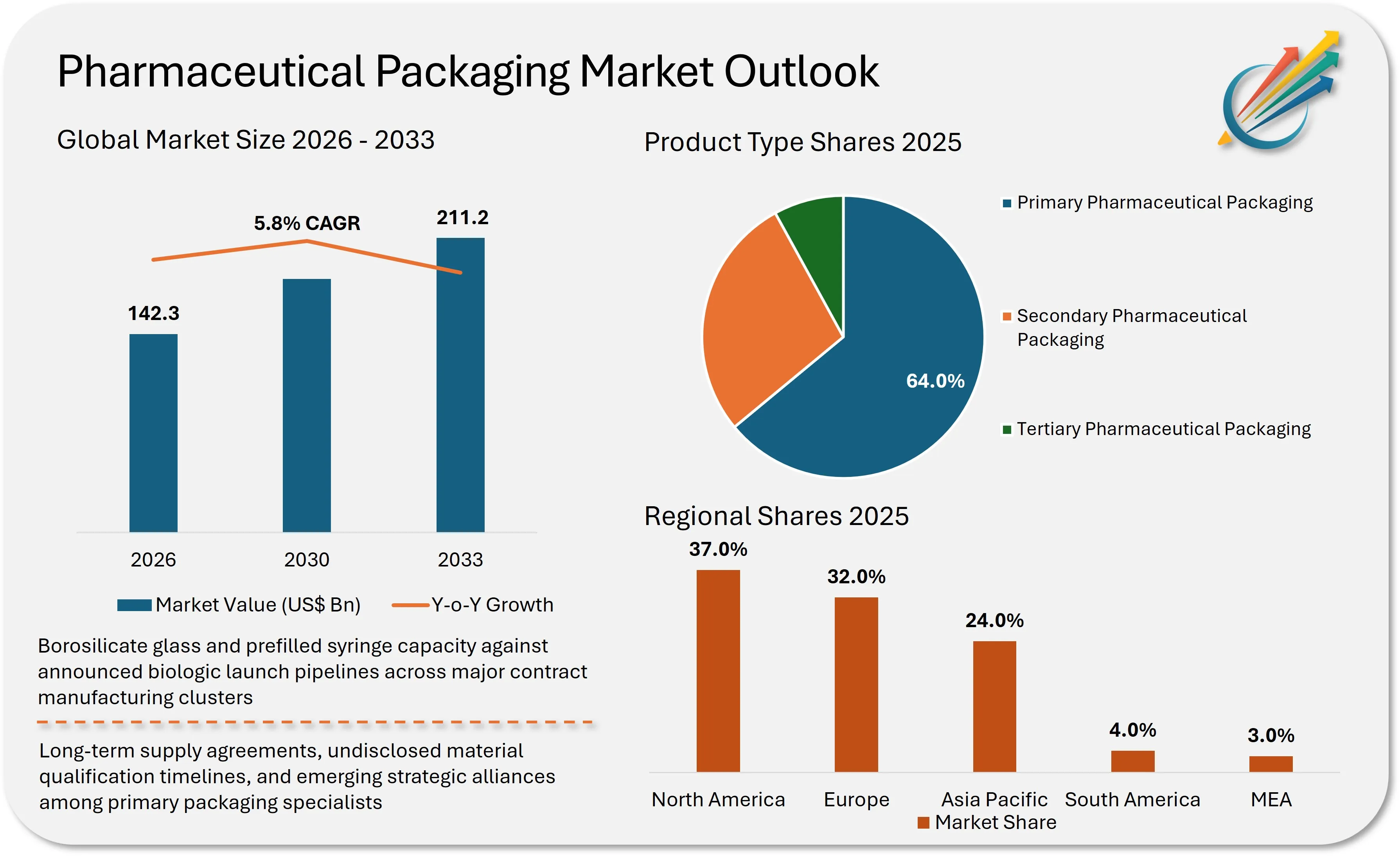
- The pharmaceutical packaging market is valued at US$ 142.3 Billion in 2026, anchored by primary packaging demand and is forecast to reach US$ 211.2 Billion by 2033 as biologics and injectables expand their share.
- Serialization and track-and-trace mandates are converting packaging into a compliance-critical function.
- Prefilled syringes and cartridges are outpacing traditional vials in primary packaging demand in the pharmaceutical packaging market.
- Type I borosilicate glass remains the default for sensitive biologic formulations.
- Sustainability requirements are pressuring plastic-heavy formats toward recyclable mono-material designs across pharmaceutical packaging market.
As per Research Manager from Market Minds Advisory, "The decisive shift is that packaging now determines whether a drug reaches market on schedule, not merely how it travels. Companies that secure specialized container capacity and qualified material supply over the next 18 to 24 months will hold a structural advantage that latecomers cannot easily price away."
A Narrow Strategic Window is Opening for Drugmakers Still Treating Packaging as a Procurement Exercise
The pharmaceutical packaging market is entering a phase where capacity decisions made now will constrain options for years. Three forces explain the urgency.
- Biologic launch density is rising: A dense wave of biologic and specialty approvals is moving through clinical pipelines, and each one requires qualified primary containment well before commercial launch. Packaging procurement that begins at filing is already late.
- Container qualification cycles are long: Validating a new vial, syringe, or cartridge supplier against regulatory and stability requirements can take many months. Buyers who delay qualification surrender scheduling flexibility to competitors who acted earlier.
- Specialized capacity is finite: High-quality borosilicate glass and prefilled syringe lines cannot be built quickly. The pharmaceutical packaging market is therefore allocating scarce capacity to buyers who commit first, not to those who negotiate hardest.
The Pharmaceutical Packaging Market is Rapidly Shifting from Commodity Containment to Engineered Pharmaceutical Systems
The most important change in the pharmaceutical packaging market is not volume growth. It is the redefinition of what packaging is expected to do.
- Packaging is becoming a clinical variable: Container choice now influences drug stability, extractables and leachables profiles, and shelf life. For biologics in particular, the package is part of the formulation decision rather than a downstream logistics choice.
- Data is migrating onto the package: Serialization, tamper evidence, and connected-packaging features are turning cartons and labels into carriers of regulatory and patient-facing information. Secondary packaging is absorbing functions that were never previously its responsibility.
- Supply assurance is outranking unit price: Procurement teams that once optimized for the lowest cost per container are now weighting continuity, qualification status, and geographic resilience far more heavily. The gap between those two postures is widening.
The Pharmaceutical Packaging Market Evolving Faster than Drug Packaging Strategies Anticipated
Glass will not be displaced by polymer alternatives as quickly as commentary suggests. For sensitive biologics, Type I borosilicate glass remains the validated default, and requalification risk keeps drugmakers conservative. Polymer containers will gain share in specific formats, but a wholesale substitution narrative overstates the near-term pace.
The binding constraint over the next several years will be qualified capacity, not material cost. Most analysis tracks resin and glass pricing. The more decisive question is which suppliers hold validated, regulator-accepted lines, because that is what actually gates a launch.
Secondary and tertiary packaging will quietly capture more strategic value than expected. Serialization, anti-counterfeiting, and cold-chain protection are concentrating in formats long treated as low-margin. The players investing here are building defensible positions while attention stays fixed on primary containers.
New Competitive Structure Forming across the Pharmaceutical Packaging Market Ecosystem
Regulatory Serialization and Traceability
Track-and-trace and serialization mandates across major regulated markets have made packaging a compliance instrument rather than a protective afterthought. Every saleable unit must now carry verifiable identity data, which forces investment in labeling precision, aggregation systems, and data integrity. Suppliers able to deliver compliant packaging as an integrated system, rather than separate components, are increasingly preferred by drugmakers managing audit and recall exposure.
The Biologics and Injectables Surge
Biologic therapies and injectable formulations are reshaping demand toward prefilled syringes, cartridges, and high-purity vials. These products are sensitive to container chemistry, demand sterile barrier assurance, and often require cold-chain compatibility. As the pharmaceutical packaging market tilts toward these formats, suppliers with specialized glass conversion and aseptic filling readiness capture disproportionate value relative to commodity packaging providers.
Sustainability and Material Redesign
Environmental regulation and corporate commitments are pressuring plastic-intensive formats toward recyclable mono-materials, reduced polymer weight, and paper-based alternatives in secondary packaging. The constraint is that any material change must survive stability and regulatory requalification. This tension is rewarding suppliers who can innovate on sustainability without compromising barrier performance, a balance few commodity converters can credibly offer today.
Supply Chain Regionalization
Recent disruption has pushed drugmakers to diversify packaging sources and shorten geographic exposure. Regional capacity, dual sourcing, and nearshored supply are now strategic priorities rather than contingency measures. This reorganization favors suppliers with distributed manufacturing footprints and disadvantages those concentrated in a single region, reshaping competitive boundaries across the pharmaceutical packaging market value chain.
Ignoring Structural Risks could delay Competitive Positioning Across Regulated Pharmaceutical Supply Chains
- Raw material volatility: Glass, resin, and aluminum input costs remain exposed to energy prices and trade conditions, compressing converter margins unpredictably.
- Regulatory requalification burden: Any material or supplier change triggers stability testing and regulatory review, slowing adoption of otherwise attractive innovations.
- Capital intensity: Specialized glass and prefilled syringe capacity demands long-lead, high-cost investment that smaller suppliers struggle to finance.
- Sustainability and performance tension: Recyclable formats must still meet strict barrier and sterility standards, limiting how fast greener designs can scale.
- Supply concentration: A narrow base of high-purity glass suppliers leaves the pharmaceutical packaging market exposed to localized disruption.
- Counterfeiting sophistication: Adversaries adapt to anti-counterfeit measures, forcing continual reinvestment in security features.
These risks are real and warrant disciplined planning, but none reverses the directional conclusion. They shape the pace and the margin profile of growth rather than its overall trajectory.
Market Dynamics Shaping the Pharmaceutical Packaging Market
Pharmaceutical Packaging Market Segmentation
By Packaging Type
- Rigid Packaging
- Flexible Packaging
- Semi-Rigid Packaging
Rigid packaging continues to anchor the pharmaceutical packaging market because vials, bottles, and ampoules remain the validated standard for injectables and sensitive oral formulations. Flexible packaging is gaining ground where weight, cost, and material efficiency matter, particularly in unit-dose and secondary applications. Semi-rigid formats occupy a practical middle position. The decisive variable across all three is whether a format can satisfy barrier and regulatory requirements without triggering costly requalification.
By Product Type
- Primary Pharmaceutical Packaging
- Blister Packaging
- Strip Packaging
- Bottles and Vials
- Ampoules
- Prefilled Syringes
- Cartridges
- Secondary Pharmaceutical Packaging
- Cartons
- Boxes
- Labels
- Inserts and Leaflets
- Tertiary Pharmaceutical Packaging
- Corrugated Shippers
- Pallet Containers
- Protective Transit Packaging
Primary packaging commands the largest value share because it is in direct contact with the drug and most exposed to regulatory scrutiny. Within it, prefilled syringes and cartridges are the fastest-moving formats. Secondary packaging is being elevated by serialization and anti-counterfeiting requirements that load cartons and labels with compliance functions. Tertiary packaging, though less visible, is increasingly engineered for cold-chain and transit protection of high-value biologics across the pharmaceutical packaging market.
By Material Type
- Glass Materials
- Type I Borosilicate Glass
- Type II Treated Glass
- Type III Soda Lime Glass
- Plastic Materials
- Polyethylene
- Polypropylene
- Polyethylene Terephthalate
- Polyvinyl Chloride
- Aluminum Materials
- Paper and Paperboard Materials
Glass retains its dominance in the pharmaceutical packaging market for injectables and biologics, with Type I borosilicate the validated default for sensitive formulations. Plastics serve high-volume oral and topical applications where cost and design flexibility outweigh barrier concerns. Aluminum supports blister and strip formats with strong moisture protection. Paper and paperboard are expanding in secondary packaging as sustainability pressure rewards recyclable, fiber-based alternatives.
By Application
- Oral Drug Packaging
- Injectable Drug Packaging
- Topical Drug Packaging
- Inhalation Drug Packaging
- Transdermal Drug Packaging
- Biologics Packaging
Oral drug packaging holds the broadest volume base, supported by blister and bottle formats serving chronic-disease therapies. Injectable and biologics packaging are the strategic growth engines, demanding engineered containment, sterility assurance, and cold-chain compatibility. Inhalation and transdermal applications occupy specialized niches where device integration matters as much as containment. Across applications, the pharmaceutical packaging market is rewarding suppliers who can match container engineering to therapeutic complexity.
Shape this report around your priorities: https://marketmindsadvisory.com/request-customization/?report_id=38
Regional Market Outlook
Investment Focus where the Lucrative Opportunity is Anticipated
Specialized Primary Containment for Biologics
The clearest opportunity sits in prefilled syringes, cartridges, and high-purity vials engineered for biologic stability. Demand is outrunning qualified capacity, and validation timelines protect incumbents. Suppliers who treat this as a strategic asset rather than a procurement step are building positions that latecomers cannot easily contest.
Integrated Serialization and Compliance Systems
Value is concentrating among suppliers who deliver serialization, aggregation, and traceability as a unified system rather than separate parts. Drugmakers managing audit and recall exposure increasingly favor partners who reduce compliance complexity. This is a durable position because switching costs rise once a compliant system is embedded.
Sustainable Material Innovation
Recyclable mono-materials and fiber-based secondary packaging that still meet barrier and regulatory standards represent a high-value frontier. The difficulty of balancing sustainability with performance is itself the moat. Suppliers who solve it credibly will capture demand that commodity converters cannot serve.
Cold-Chain and Transit Engineering
As temperature-sensitive biologics expand, tertiary packaging engineered for thermal protection and transit integrity becomes strategically important. This area is underweighted in market commentary, which makes it attractive. Suppliers building specialized cold-chain capability are positioning ahead of a demand curve that is steepening.
What This Means for Decision-Makers
Pharmaceutical Manufacturers - Packaging procurement can no longer begin at regulatory filing. Qualifying specialized primary containment suppliers early, particularly for biologics and injectables, is now a launch-timing decision rather than a cost decision, and treating it otherwise cedes scheduling advantage to competitors.
Packaging Suppliers - The defensible position is engineered containment and integrated compliance, not commodity conversion. Investment in qualified capacity, serialization systems, and sustainable materials within the pharmaceutical packaging market builds switching costs that protect margin against price-based competition.
Investors - The thesis has matured past volume growth. Specialized glass capacity, prefilled syringe lines, and integrated compliance providers offer clearer risk-return profiles than commodity packaging exposure, where margins remain pressured by input volatility.
Procurement and Supply Chain Leaders - Supply continuity, qualification status, and geographic resilience now outweigh unit price. Dual sourcing and regional capacity should be treated as strategic priorities, because the cost of a packaging disruption far exceeds any near-term savings.
Competitive Landscape: Pharmaceutical Packaging Market
Recent Market Developments
- In April 2026, Gerresheimer AG advanced expansion of its high-value prefilled syringe and biologic containment production capacity to address rising specialty drug demand.
- In March 2026, Stevanato Group continued scaling its glass conversion and prefilled syringe manufacturing footprint to support growing injectable and biologic packaging requirements.
- In February 2026, West Pharmaceutical Services reinforced investment in containment and delivery systems aligned with expanding biologic and injectable pipelines.
- In January 2026, Schott Pharma progressed development of its polymer and glass primary packaging portfolio for sensitive injectable applications.
Market is segmented by Packaging Type (Rigid, Flexible, Semi-Rigid), Product Type (Primary, Secondary, Tertiary), Material Type (Glass, Plastic, Aluminum, Paper and Paperboard), and Application (Oral, Injectable, Topical, Biologics)
Get Access to complete Analysis, Buy Now: https://marketmindsadvisory.com/buy-now/?report_id=38
Trending Reports
- Food Grade Bottles Market
- Foodservice Disposable Market
- Corrugated Box Printer Slotter Machine Market
- Food Tub Packaging Market
- Cornstarch Packaging Market
- Food Storage Bags Market
- Corrugated Boxes Market
- HDPE Containers Market
- Corrugated Octabins Market
- Corrugated Bubble Wrap Market
Why choose Market Minds Advisory
Market Minds Advisory delivers decision-grade intelligence to executives across machinery, packaging, chemicals, automotive, ICT, food and beverage, consumer goods, and healthcare. We help organizations sharpen market expansion strategies, accelerate share gains, refine brand positioning, and enable account-level growth. Our forecasting integrates primary interviews, proprietary demand models, and continuous market validation, producing the kind of clarity volatile and emerging industries require. Backed by over a decade of sector expertise, our research surfaces white space, opportunity gaps, and competitive blind spots, accounting for recent developments and geopolitical risk. We help businesses see the future of their markets.
Contact Us
Market Minds Advisory
1521 Concord Pike, Suite 301
Wilmington, DE 19803
United States
Email: sales@marketmindsadvisory.com
Website: https://marketmindsadvisory.com/



Comments (0)
Login to join the conversation
Login / RegisterNo comments yet. Be the first to comment!