
The next margin opportunity may already be inside the formulation: multifunctional ingredients can replace multiple inputs while improving performance, positioning and economics.
Wilmington, DE, United States, Sept. 10, 2026 (GLOBE NEWSWIRE) -- Functional Food Ingredients Market Emerging as one of the most Strategically Controlled Layers of Modern Nutrition
The conversation about what goes into food has shifted. Consumers no longer ask only whether a product tastes good or costs less. They ask what it does for digestion, immunity, and long-term health, and that single change is rewriting supplier economics across the functional food ingredients market. The companies reading this shift correctly are already repositioning.
What looks like steady category growth is, underneath, a contest over access. Specialized strains, clinically backed actives, and traceable natural inputs are finite, and the brands securing them early are quietly building advantages competitors cannot replicate on price alone. The gap between firms that plan their ingredient strategy and those that simply purchase is widening each quarter.
Request a Free Sample Report: https://marketmindsadvisory.com/request-sample/?report_id=43
Key Takeaways from Functional Food Ingredients Market
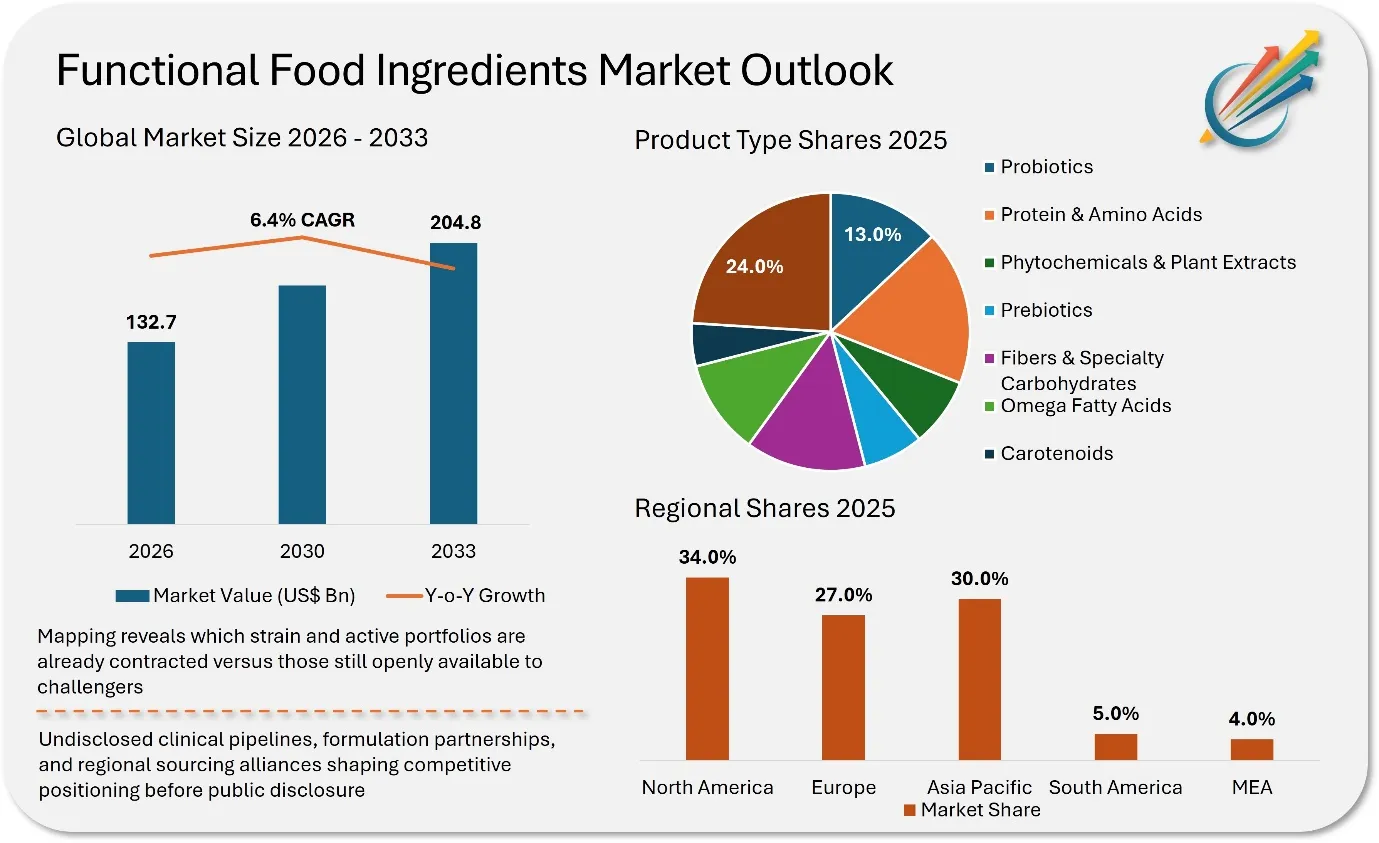
- The functional food ingredients market is valued at US$ 132.7 billion in 2026, anchoring a sizable global demand base and is expected to reach US$ 204.8 billion by 2033, the sector signals durable, structural expansion.
- Probiotics and prebiotics are absorbing a disproportionate share of clinical validation investment across functional food ingredients market.
- Plant-based and fermentation-derived sources are gaining ground on synthetic alternatives.
- Regulatory scrutiny of health claims is raising the value of evidence-backed ingredients.
- Powder formats dominate volume, but capsule and liquid delivery are capturing premium margin all over functional food ingredients market.
As per Senior Analyst from Market Minds Advisory, "The decisive question has moved from formulation to supply security, and few procurement teams have adjusted. Companies that lock in clinically validated ingredient sources over the next four to six quarters will set the cost and credibility terms competitors spend the rest of the decade chasing."
Early Movers Quietly Locking Clinically Validated Ingredient access ahead of Competitors
- Validation cycles are lengthening: Clinical substantiation for health claims now takes quarters, not weeks. Brands that begin securing evidence-backed actives now will reach shelves while slower competitors are still commissioning studies.
- Premium sourcing is consolidating: High-quality probiotic strains and traceable plant extracts sit with a narrowing set of suppliers. Early relationships translate directly into supply certainty and negotiating leverage.
- Consumer trust is becoming measurable: Shoppers increasingly verify ingredient claims, and brands built on substantiated functional benefits command pricing power that generic reformulation cannot match.
Functional Food Ingredients Market is moving from Bulk Ingredient Supply to Evidence-Backed Functional Systems
Industry coverage tends to track volume growth. The more consequential change is the move from commodity ingredient supply toward differentiated, evidence-backed inputs that reshape who holds margin.
- Ingredients are migrating up the value chain: Suppliers that once sold undifferentiated bulk material are now selling validated functionality, clinical data, and formulation support, which changes both pricing and customer relationships.
- Natural and fermentation sources are displacing synthetics: Microbial and plant-derived inputs are scaling fast enough to compete on cost, not only on label appeal, narrowing the historical price gap that protected synthetic producers.
- Delivery format is becoming a strategic decision: The choice between powder, liquid, and capsule formats now shapes target demographics and margin structure, making form a positioning lever rather than a packaging afterthought.
Functional Food Ingredients Market Evolving faster than most Nutrition and Formulation Strategies Anticipated
Synthetic ingredient sourcing will lose share faster than current forecasts assume. As fermentation economics improve, the cost advantage that kept synthetics competitive is eroding, and clean-label pressure accelerates the switch. The relevant question is which synthetic categories survive, not whether the shift happens.
Consolidation will concentrate around clinically validated ingredient portfolios rather than scale alone. Acquirers will pay premiums for proven actives and proprietary strains, not simply for capacity. Several mid-sized specialists with strong evidence libraries are more strategically valuable than their revenue suggests.
Beverages, not supplements, will become the most contested application battleground. Functional drinks reach mainstream consumers at a scale capsules never will, and the brands that solve taste and stability constraints first will capture outsized share.
Structural Forces Reshaping the Functional Food Ingredients Market
Shifting consumer health priorities
Demand has moved from generic wellness toward specific, outcome-driven benefits such as gut health, immune resilience, and metabolic balance. This precision reshapes what manufacturers buy, favoring ingredients with documented physiological effects over broad nutritional positioning. Suppliers that can connect an ingredient to a measurable health outcome are increasingly the ones setting terms across the functional food ingredients market.
Tightening regulatory expectations
Health claim enforcement is becoming stricter across major markets, and the cost of unsubstantiated marketing is rising. This raises the strategic value of ingredients backed by clinical evidence and traceable sourcing. Regulation, often framed as a constraint, is functioning here as a competitive sorting mechanism that rewards prepared suppliers and penalizes opportunistic ones.
Advances in fermentation and bioprocessing
Improvements in microbial production and precision fermentation are lowering the cost of probiotics, specialty proteins, and other actives once expensive to produce naturally. This expands the addressable use of premium ingredients into mainstream price tiers. The producers investing in bioprocessing capability today are positioning to supply categories that were previously uneconomical to serve.
Mainstreaming of functional formats
Functional benefits are no longer confined to supplements and niche health products. They are entering everyday bakery, dairy, snacks, and beverage categories, broadening demand and changing volume expectations. This mainstreaming pulls ingredient suppliers into closer collaboration with large food manufacturers, altering both relationship depth and contract structure.
Ignoring Structural Risks Could Delay Competitive Positioning across Functional Food Ingredients Market
- Regulatory divergence: Inconsistent health claim rules across regions complicate product standardization and raise compliance costs for multi-market players.
- Raw material volatility: Climate pressure and agricultural variability create supply uncertainty for plant-derived and natural ingredients.
- Clinical evidence costs: Substantiation studies are expensive and slow, disadvantaging smaller suppliers without research budgets.
- Consumer skepticism: Overuse of wellness language risks claim fatigue, where shoppers discount functional benefits regardless of validity.
- Price sensitivity: In cost-pressured categories, premium functional ingredients face resistance from manufacturers protecting margins.
- Supply concentration: Reliance on a narrow set of specialized strain and active producers exposes brands to sourcing risk.
These risks are real and warrant active management, but none reverses the underlying direction. They shape the pace and the winners, not the destination.
Market Dynamics Shaping the Functional Food Ingredients Market
Functional Food Ingredients Market Segmentation
By Product Type
- Probiotics
- Protein & Amino Acids
- Phytochemicals & Plant Extracts
- Prebiotics
- Fibers & Specialty Carbohydrates
- Omega Fatty Acids
- Carotenoids
- Minerals & Vitamins
Probiotics and prebiotics anchor the digestive health narrative that drives much of current demand, and they attract the heaviest clinical investment. Protein and amino acids benefit from sustained interest in active nutrition, while phytochemicals gain from clean-label momentum. Minerals and vitamins remain a stable volume base, though differentiation increasingly comes from delivery and bioavailability rather than the nutrient itself within the functional food ingredients market.
By Source
- Natural Sources
- Plant-based Sources
- Animal-based Sources
- Microbial & Fermentation Sources
- Synthetic Sources
- Blended Sources
Natural sources are gaining structural share as clean-label expectations harden and fermentation economics improve. Microbial and fermentation routes are the most strategically dynamic, lowering costs for actives once tied to expensive extraction. Synthetic sources retain relevance where precision and cost favor them, but their share is under pressure. Blended sources offer manufacturers a practical bridge between performance, cost, and label positioning across functional food ingredients market.
By Form
- Powders
- Liquid
- Capsules & Tablets
- Others
Powders dominate volume due to formulation flexibility and stability across food applications. Liquid formats are expanding with functional beverage growth, though they introduce stability challenges. Capsules and tablets concentrate in the supplement channel, where dosing precision supports premium pricing. Form choice increasingly reflects target consumer and margin strategy rather than technical default within the functional food ingredients market.
By Application
- Food
- Infant Food
- Dairy Products
- Bakery Products
- Confectionery Products
- Snacks
- Meat & Meat Products
- Others
- Beverages
- Energy Drinks
- Juices
- Health Drinks
- Nutraceuticals & Dietary Supplements
Food remains the largest application base, with dairy and bakery absorbing functional ingredients at scale. Beverages are the fastest-evolving battleground, as functional drinks reach mainstream consumers and reward brands that solve taste and stability in the functional food ingredients market. Nutraceuticals and dietary supplements deliver the highest margin per unit, but face crowding. The strategic contest is shifting toward embedding functionality into everyday food and drink rather than niche supplementation.
By Function
- Digestive Health
- Immune Support
- Energy & Metabolism
- Heart Health
- Bone & Joint Health
- Weight Management
- Others
Digestive and immune health dominate consumer demand and command the strongest evidence base. Energy and metabolism benefit from active lifestyle trends, while heart and bone health appeal to aging demographics. Weight management remains commercially significant but exposed to shifting consumer sentiment across functional food ingredients market. Function is becoming the primary lens through which manufacturers select ingredients, displacing source and form as the first decision.
Shape this report around your priorities: https://marketmindsadvisory.com/request-customization/?report_id=43
Regional Market Outlook
Investment Focus where the Lucrative Opportunity is Anticipated
Clinically validated ingredient portfolios
The most defensible positions belong to suppliers holding proven, evidence-backed actives. As regulators tighten claim enforcement, clinical data becomes a barrier to entry that capital alone cannot quickly replicate. Investors should treat validated portfolios as durable assets rather than replaceable inventory within the functional food ingredients market.
Fermentation and bioprocessing capability
Precision fermentation is reshaping cost structures for probiotics and specialty actives. Companies with proven bioprocessing capability can serve premium and mainstream tiers simultaneously. This capability is difficult to build quickly, making it one of the more attractive long-term positions in the sector.
Functional beverage formulation expertise
Beverages are where functional benefits reach mainstream scale. Firms that solve taste, stability, and shelf-life constraints hold expertise that brand owners increasingly cannot develop internally. This formulation know-how is becoming a high-value, defensible niche as beverage competition intensifies.
Traceable natural sourcing networks
Secure, traceable supply of plant-derived and microbial inputs is becoming a strategic asset. As clean-label demand hardens, suppliers with verified sourcing networks command both trust and pricing power. These networks take years to build, protecting early movers from fast followers.
What This Means for Decision-Makers
Food and Beverage Manufacturers - Treating ingredient sourcing as a strategic function rather than a procurement step is now decisive. Securing validated, traceable inputs early protects both margin and claim credibility as competition for premium supply intensifies.
Ingredient Suppliers - Differentiation through clinical evidence and natural sourcing is becoming the binding constraint on growth. Suppliers that invest in substantiation and fermentation capability will set terms; those competing on price alone will see margins compress.
Investors - The most attractive positions in the functional food ingredients market lie in validated portfolios, bioprocessing capability, and traceable sourcing networks. These assets carry clearer risk-return profiles than commodity ingredient exposure.
Policymakers - Clearer, more consistent health claim frameworks would reduce compliance friction and improve consumer trust. Regulatory coordination across regions would accelerate responsible innovation while curbing unsubstantiated marketing.
Competitive Landscape: Functional Food Ingredients Market
Recent Market Developments
- In April 2026, Kerry Group expanded its portfolio of probiotic and proactive health solutions aimed at digestive and immune applications.
- In March 2026, ADM strengthened its fermentation and microbiome capabilities to broaden its functional ingredient offering.
- In February 2026, Tate & Lyle advanced its specialty fiber and prebiotic portfolio in response to rising digestive health demand.
- In January 2026, Ingredion expanded its plant-based protein and specialty ingredient capacity to support functional food applications.
Market is segmented by Product Type (Probiotics, Protein, Amino Acids, Phytochemicals & Plant Extracts), Source (Natural, Synthetic, Blended), Form (Powders, Liquid, Capsules), and Application (Food, Beverages, Nutraceuticals & Dietary Supplements)
Get Access to complete Analysis, Buy Now: https://marketmindsadvisory.com/buy-now/?report_id=43
Trending Reports
- Plant-Based Ingredients Market
- Artificial Preservative Market
- Natural Flavor Market
- Plant-Based Ingredients Market
- Powdered Beverage Market
- Bakery Ingredients Market
- Non-Dairy Creamer Market
- Sugar Confectionery Market
- Plant-Based Snacks Market
- Ready-to-Drink (RTD) Beverage Market
Why choose Market Minds Advisory
Market Minds Advisory delivers decision-grade intelligence to executives across machinery, packaging, chemicals, automotive, ICT, food and beverage, consumer goods, and healthcare. We help organizations sharpen market expansion strategies, accelerate share gains, refine brand positioning, and enable account-level growth. Our forecasting integrates primary interviews, proprietary demand models, and continuous market validation, producing the kind of clarity volatile and emerging industries require. Backed by over a decade of sector expertise, our research surfaces white space, opportunity gaps, and competitive blind spots, accounting for recent developments and geopolitical risk. We help businesses see the future of their markets.
Contact Us
Market Minds Advisory
1521 Concord Pike, Suite 301
Wilmington, DE 19803
United States
Email: sales@marketmindsadvisory.com
Website: https://marketmindsadvisory.com/








Comments (0)
Login to join the conversation
Login / RegisterNo comments yet. Be the first to comment!