
U.S. Market Forecast at USD 3.32 Billion and Europe at USD 2.70 Billion by 2035 as Gene-Editing Advances and Manufacturing Expansion Support Growth
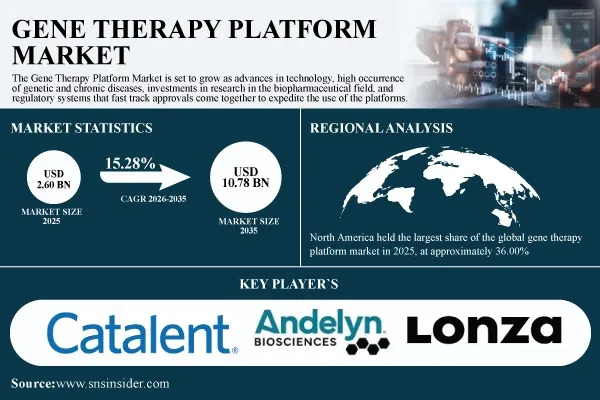
Austin, United States, Aug. 26, 2026 (GLOBE NEWSWIRE) -- According to SNS Insider, The Gene Therapy Platform Market was valued at USD 2.60 Billion in 2025 and is expected to reach USD 10.78 Billion by 2035, growing at a CAGR of 15.28% from 2026 to 2035. The market is estimated at USD 3.00 Billion in 2026. Market growth is facilitated by advancements in viral vectors, CRISPR technology, and other forms of gene editing, high prevalence of genetic and chronic diseases, biopharmaceutical research spending, and increase in manufacturing capacity for gene therapies.
CDMOs are fueling the growth of this market by providing services for process development, regulatory assistance, production scale-up, and GMP manufacturing. Other emerging trends in this sector include the use of artificial intelligence and automation, as well as non-viral delivery systems.
Download the Gene Therapy Platform Market Sample Report: https://www.snsinsider.com/sample-request/7679
Key Market Highlights
- Market size, 2025: USD 2.60 Billion
- Market size, 2026E: USD 3.00 Billion
- Market forecast, 2035: USD 10.78 Billion
- CAGR: 15.28% from 2026 to 2035
- Largest region: North America, approximately 36.00% share in 2025
- Fastest-growing region: Asia Pacific
- Largest platform type: Viral vector platforms, approximately 58.12% share in 2025
- Largest end-use: On-premise R&D, approximately 55.00% share in 2025
Market Relevance
Gene therapy platforms offer the technological capability and manufacturing platform that is necessary for developing therapies for genetic disorders, rare disease conditions, and cancer. The need is rising owing to the growth of pipeline by pharmaceutical and biotechnology firms in gene therapy with viral vectors, non-viral delivery, gene editing, and manufacturing.
Growing use of CDMOs is also changing the market structure. Smaller biotechnology companies increasingly rely on external partners for process development, regulatory compliance, GMP manufacturing, and scale-up production rather than building dedicated internal facilities.
Market Overview
The market includes viral vector platforms, non-viral vector platforms, in vivo and ex vivo delivery approaches, gene-editing technologies, and specialized manufacturing services. Viral vectors remain the leading platform type, while lipid nanoparticles and other non-viral approaches are gaining adoption because of their scalability and lower immunogenicity.
Artificial intelligence, automation, and improved AAV and lentiviral vector production methods are supporting better manufacturing efficiency and batch consistency. Continued development of CRISPR and related gene-editing tools is further expanding the therapeutic potential of gene therapy platforms.
Strategic Market Outlook
The strongest opportunities are emerging in non-viral delivery and outsourced manufacturing. Lipid nanoparticles and other non-viral platforms offer potential advantages in scalability and manufacturing simplicity, while CDMOs are benefiting from growing demand for integrated plasmid production, vector manufacturing, process development, and fill-finish services.
However, high development costs, limited GMP-grade vector capacity, purification bottlenecks, and manufacturing complexity remain important restraints. These challenges are particularly significant for smaller biotechnology companies and personalized autologous therapies.
Segment Analysis
By Type of Platform: The viral vector platforms accounted for nearly 58.12% market share in 2025, driven by the use of AAV and lentiviral vectors in approved and late-stage pipelines. Non-viral vector platforms are predicted to register highest growth rate, driven by the rising use of lipid nanoparticles.
By Application: Oncology led in terms of share in 2025 due to gene therapy platforms that supported CAR-T cell and other cancer immunotherapy programs. The rare genetic disorders are forecasted to register the highest growth rate driven by huge unmet need, regulatory drivers, and rising number of therapies under development for orphan diseases.
By Delivery Method: In vivo was the leading method in 2025 due to the possibility of delivering genetic material directly into the body. The ex vivo method is expected to register the highest growth rate driven by the rising number of CAR-T cell and stem-cell based therapies.
By End-Use: On-premise R&D accounted for around 55.00% market share in 2025 due to the availability of complete control over development, manufacturing, logistics, and CMC processes. CDMOs are predicted to witness highest growth rate driven by biotech companies outsource manufacturing and regulatory functions.
Regional Analysis
North America constituted about 36.00% of the total Global Gene Therapy Platform Market in 2025, which made it the biggest region in the market. The United States accounted for approximately 85.70% of revenues in North America and the size of the market in 2025 was valued at USD 0.80 Billion, while the projected size was forecasted at USD 3.32 Billion in 2035 at a CAGR of 15.30%.
Europe is anticipated to grow from USD 0.70 Billion in 2025 to USD 2.70 Billion in 2035, at a CAGR of 14.40%. Germany constituted approximately 27.50% of revenue share in Europe in 2025 because of its biotechnology and gene therapy manufacturing facilities.
The Asia-Pacific region is expected to witness fastest growth during the forecast period. China constituted approximately 36.60% of the revenue in the region in 2025 owing to biotechnological investments and supportive policies, clinical trials, and manufacturing capacities.
Buy the Gene Therapy Platform Market Report with Competitive Analysis and 2035 Forecast: https://www.snsinsider.com/checkout/7679
Key Industry Trends
- Increasing adoption of viral vector gene therapy platforms
- Growing use of non-viral delivery systems and lipid nanoparticles
- Expansion of CRISPR and advanced gene-editing technologies
- Increasing use of artificial intelligence and automation in manufacturing
- Growth of CDMO gene therapy manufacturing capacity
- Rising investment in oncology and rare genetic disease therapies
- Increasing focus on GMP manufacturing and commercial-scale production
Competitive Landscape
The Gene Therapy Platform Market faces intense competition with respect to viral vectors, non-viral delivery, gene editing, process development, and CDMOs. These companies are increasing their manufacturing capabilities, enhancing AAV vector and lentiviral vector manufacturing and also developing an integrated gene therapy platform.
Some of the major key players are Catalent, Inc., Andelyn Biosciences, Inc., Bluebird Bio, Inc., CRISPR Therapeutics AG, Vertex Pharmaceuticals Incorporated, Lonza Group AG, Forge Biologics, Inc., 64x Bio, Inc., ProBio, Thermo Fisher Scientific Inc., Charles River Laboratories International, Inc., WuXi AppTec Co., Ltd., Oxford Biomedica plc, Sarepta Therapeutics, Inc., Novartis AG, Pfizer Inc., Spark Therapeutics, Inc., uniQure N.V., Genethon, and REGENXBIO Inc.
Explore the Complete Gene Therapy Platform Market Report: https://www.snsinsider.com/reports/gene-therapy-platform-market-7679
CONTACT: About Us:
SNS Insider is one of the leading market research and consulting agencies that dominates the market research industry globally. Our company's aim is to give clients the knowledge they require in order to function in changing circumstances. In order to give you current, accurate market data, consumer insights, and opinions so that you can make decisions with confidence, we employ a variety of techniques, including surveys, video talks, and focus groups around the world.

Contact Us:
Rohan Jadhav - Principal Consultant
Phone: +1-315-961-9094 (US)
Email: info@snsinsider.com





Comments (0)
Login to join the conversation
Login / RegisterNo comments yet. Be the first to comment!