
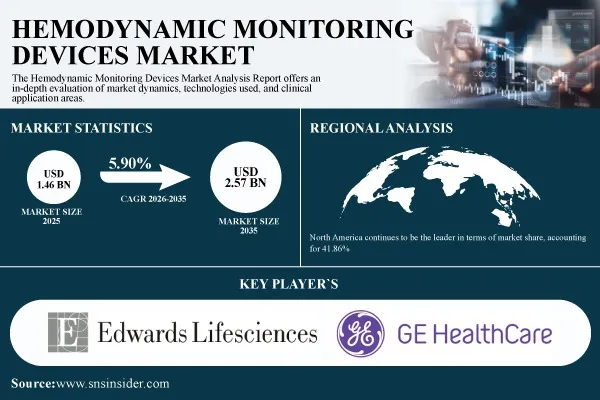
The U.S. Hemodynamic Monitoring Devices Market to reach USD 0.89 Billion and Europe USD 0.71 Billion by 2035, supported by expanding ICU capacity, rising surgical volumes, and growing adoption of AI-enabled, predictive and non-invasive monitoring technologies.
Austin, United States, Aug. 21, 2026 (GLOBE NEWSWIRE) -- The Hemodynamic Monitoring Devices Market Size was valued at USD 1.46 Billion in 2025 and is projected to reach USD 2.57 Billion by 2035, growing at a CAGR of 5.90% during 2026–2035, according to a new report by SNS Insider. The global market growth is fuelled by the increasing demand for intensive care monitoring, the prevalence of various diseases related to the cardiovascular and respiratory system, and technological advancements such as non-invasive and AI-based monitoring techniques.
Hemodynamic monitoring devices are being increasingly employed in ICU's, operating theatres, emergency departments and similar critical care environments for measuring cardiovascular efficiency and making appropriate decisions. Companies are coming up with advanced non-invasive monitoring technology, predictive analytics, and artificial intelligence platforms in order to improve patient safety, treat hypotension and enhance clinical monitoring.
Download the Hemodynamic Monitoring Devices Market Sample Report: https://www.snsinsider.com/sample-request/10015
Hemodynamic Monitoring Devices Market Growth Supported by Critical Care and AI Adoption
The increasing number of ICU admissions, increasing surgeries, and increased prevalence of heart and respiratory diseases make hemodynamic monitoring a necessity. There is an increased adoption of invasive, minimally invasive, and non-invasive monitoring equipment. The use of AI predictive analysis and remote monitoring tools is bringing in new opportunities.
Key Market Takeaways
- Leading Type: Invasive, with a 34.62% share in 2025
- Leading Product: Disposables, with a 54.28% share
- Leading Application: ICU/CCU, with a 39.29% share
- Leading End User: Hospitals, with a 64.16% share
- Largest Regional Market: North America, with a 41.86% share
- Fastest-Growing Region: Asia Pacific, at an 8.04% CAGR
North America Leads the Hemodynamic Monitoring Devices Market While Asia Pacific Registers the Fastest Growth
North America held the largest share of the Hemodynamic Monitoring Devices Market in 2025 at 41.86%. It is attributed to the region’s robust healthcare system, increasing number of surgeries, growth in critical care facilities, and adoption of invasive and non-invasive monitoring techniques. The rising adoption of predictive analytics and artificial intelligence-driven monitoring solutions is aiding this trend.
In 2025, the U.S. Hemodynamic Monitoring Devices Market size was valued at USD 0.53 billion and it is estimated to grow to USD 0.89 billion during 2035, with a CAGR of 6.07%. The market is expected to grow due to increasing ICU capacity, increasing number of surgical operations, and increased use of predictive analysis and monitoring devices.
In 2025, the value of the Europe Hemodynamic Monitoring Devices Market reached USD 0.41 billion and it is projected to reach USD 0.71 billion by 2035, with a CAGR of 5.63%. The growth will be fueled by advanced healthcare facilities, quality critical care facilities, and growing usage of both invasive and non-invasive hemodynamic monitoring devices.
Asia-Pacific region is likely to experience the highest growth rate, with a CAGR of 8.04% in the period from 2026 to 2035. The growth will be driven by an increase in surgical procedures, an increase in ICU bed capacity, increased incidence rates of heart and lung disease, and increased healthcare investments. Key markets are likely to remain China, India, Japan, and South Korea.
Segmentation Analysis:
Invasive Monitoring Leads the Market by Type
The invasive segment holds about 34.62% share in 2025, which is highly dependable for critical care and operating rooms where over 15 million procedures are performed through invasive devices. The non-invasive devices are the fastest growing category, having a 6.66% CAGR owing to increased patient preference in terms of comfort and reduced infection risks and telehealth usage where over 9 million procedures were observed.
Disposables Hold the Largest Product Share
The disposables accounted for the highest market share with approximately 54.28%, performing an important function in both invasive and non-invasive monitoring with approximately 120 million devices in use in ICU departments and surgery wards. The fastest-growing segment within the market is Software & Data Analytics with a CAGR of 7.81%, which is being fueled by AI-based monitoring systems.
ICU/CCU Dominates Hemodynamic Monitoring Applications
ICU/CCU has taken lead with about 39.29% market share in 2025, becoming an essential component of hospitals that treat difficult respiratory or cardiovascular disorders with a number of procedures performed each year exceeding 10 million. The fastest-growing application is Emergency Department with a CAGR of 8.50%, fueled by the higher volume of accidents and surgical cases.
Hospitals Account for the Largest End-Use Share
Hospitals accounted for a majority market share of 64.16% in 2025 owing to their big capacity in terms of ICUs as well as surgery wings, which are expected to perform above 18 million procedures. Home Care Settings are expected to grow at the fastest CAGR of 8.89% during the forecast period owing to the increasing demand for telehealth and remote monitoring globally.
Access the Hemodynamic Monitoring Devices Market Report with Competitive Analysis and 2035 Forecast: https://www.snsinsider.com/reports/hemodynamic-monitoring-devices-market-10015
Hemodynamic Monitoring Devices Market Report Scope
| Report Attributes | Details |
| Market Size in 2025 | USD 1.46 Billion |
| Market Size by 2035 | USD 2.57 Billion |
| CAGR | CAGR of 5.90% From 2026 to 2035 |
| Base Year | 2025 |
| Forecast Period | 2026-2035 |
| Historical Data | 2022-2024 |
| Key Segments | • By Type (Invasive, Minimally Invasive, Non-Invasive, Others), • By Product (Disposables (catheters, sensors), Monitors (systems, software), Software & Data Analytics (AI-driven platforms), Accessories (cables, connectors, disposables linked to monitors), Others) , • By Application (ICU/CCU, Cardiopulmonary Department, Neurosurgery, Emergency Department, Others), • By End Use (Hospitals, Ambulatory Surgical Centers, Home Care Settings, Others) |
| Regional Analysis/Coverage | North America (US, Canada), Europe (Germany, UK, France, Italy, Spain, Russia, Poland, Rest of Europe), Asia Pacific (China, India, Japan, South Korea, Australia, ASEAN Countries, Rest of Asia Pacific), Middle East & Africa (UAE, Saudi Arabia, Qatar, South Africa, Rest of Middle East & Africa), Latin America (Brazil, Argentina, Mexico, Colombia, Rest of Latin America). |
Leading Companies in the Hemodynamic Monitoring Devices Market
- Edwards Lifesciences
- Koninklijke Philips
- GE HealthCare Technologies Inc.
- Getinge AB
- Baxter International Inc.
- LiDCO Group
- ICU Medical Inc.
- Drägerwerk AG & Co. KGaA
- Mindray Medical International
- Nihon Kohden Corporation
- Siemens Healthineers
- Medtronic plc
- Becton Dickinson (BD)
- Terumo Corporation
- Abbott Laboratories
- Schiller AG
- Deltex Medical Group
- Pulsion Medical Systems (Maquet/Getinge subsidiary)
- Osypka Medical GmbH
- CNSystems Medizintechnik GmbH
Recent Developments
August 2025: Edwards Lifesciences advanced its Acumen IQ sensor platform with enhanced predictive algorithms for hypotension management, strengthening its perioperative monitoring capabilities.
April 2025: Philips expanded its IntelliVue X3 portable monitor line with wireless hemodynamic modules to support mobility and remote patient monitoring in critical care environments
Buy the Hemodynamic Monitoring Devices Market Report with Competitive Analysis and 2035 Forecast: https://www.snsinsider.com/checkout/10015
Frequently Asked Questions (FAQs):
Q: What unique trend is shaping the market beyond traditional monitoring?
A: AI-based predictive monitoring platforms and growing adoption of wearable, telehealth-integrated devices are shaping the market beyond traditional hemodynamic monitoring.
Q: Which end-use setting is expanding most rapidly?
A: Home Care Settings are expanding fastest at an 8.89% CAGR through 2035.
Q: Which application contributes the largest share?
A: ICU/CCU contributes the largest share at around 39.29% in 2025.
Q: What is the fastest-growing product category?
A: Software & Data Analytics is the fastest-growing product category at a 7.81% CAGR.
Q: Which segment is expected to dominate the market by 2035?
A: Non-Invasive monitoring is expected to see the fastest growth by type, gradually narrowing the gap with Invasive's current dominant share.
Related Market Reports
About Us:
SNS Insider is one of the leading market research and consulting agencies that dominates the market research industry globally. Our company's aim is to give clients the knowledge they require in order to function in changing circumstances. In order to give you current, accurate market data, consumer insights, and opinions so that you can make decisions with confidence, we employ a variety of techniques, including surveys, video talks, and focus groups around the world.
CONTACT: Contact Us:
Rohan Jadhav - Principal Consultant
Phone: +1-315-961-9094 (US)
Email: info@snsinsider.com






Comments (0)
Login to join the conversation
Login / RegisterNo comments yet. Be the first to comment!