
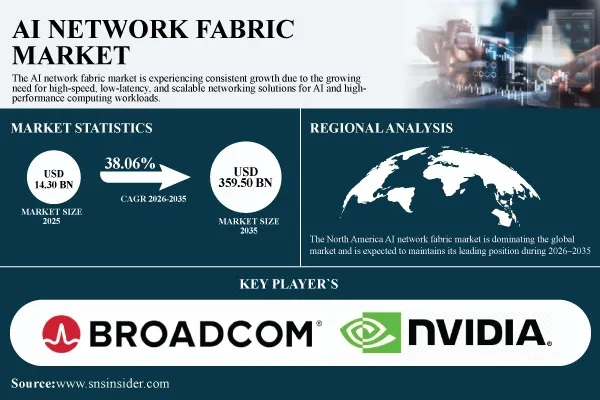
The AI Network Fabric Market is projected to reach USD 359.50 billion by 2035, growing at a CAGR of 38.06%, while the U.S. market is expected to reach USD 109.65 billion, advancing at a CAGR of 36.06%, driven by rising demand for high-performance fabric solutions as AI data centers expand.
Austin, United States, Sept. 22, 2026 (GLOBE NEWSWIRE) -- The global AI Network Fabric Market was valued at USD 14.30 billion in 2025 and is projected to reach USD 359.50 billion by 2035, expanding at a CAGR of 38.06% during 2026–2035. Demand is being driven by artificial intelligence, generative AI, large language models, accelerated computing, GPU clusters, Ethernet AI fabric, InfiniBand, NVLink/NVSwitch, and newer UALink technologies.
The U.S. AI Network Fabric Market was valued at approximately USD 5.03 billion in 2025 and is projected to reach approximately USD 109.65 billion by 2035, growing at a CAGR of 36.06% during 2026–2035. AI data center growth, GPU-accelerated computing, hyperscale data center infrastructures, and increased investment in AI fabric solutions such as Ethernet-based, InfiniBand, NVLink/NVSwitch, and new UALink technologies are driving market growth.
Download PDF Sample of AI Network Fabric Market @https://www.snsinsider.com/sample-request/10896
Why this Market is Gaining Attention in 2026
Larger AI Models Are Raising Network Bandwidth Requirements
Network fabrics for AI applications are more associated with the scale and complexity of AI applications rather than traditional data center networks. For example, generative AI, large language models, and computing accelerations require fast connectivity among GPUs, CPUs, storage, and other computing components.
As AI applications continue to scale, network fabrics become critical for minimizing communication limitations while maintaining efficient resource utilization.
Ethernet-Based AI Fabrics Are Creating a Parallel Opportunity for Networking Providers
Ethernet-based AI networks are growing rapidly due to their established ecosystems, scalability, and compatibility with existing data center infrastructure. Hyperscalers, cloud service providers, and enterprises are now turning to high-performing Ethernet solutions for connecting large GPU clusters and handling intensive east-west traffic.
This opportunity benefits suppliers of switches, network interface cards (NICs), optical connections, and processors capable of delivering higher bandwidth and lower latency.
Scale-Up Architectures and UALink Expand the AI Fabric Opportunity
It is also reaching out to scale-up networks. Scale-up fabrics enable faster communication among accelerators within single AI computing platforms, reducing data transfer limitations caused by growing model sizes and increasing numbers of accelerators.
New UALink-based architectures support openness and high-speed connections among accelerators while increasing competition in the proprietary interconnect technologies space. The addressable value chain for these companies is expanding to include switches, accelerator interconnects, software, and network management technologies.
If You Need Any Customization on AI Network Fabric Market Report, Inquire Now @https://www.snsinsider.com/enquiry/10896
Commercial Findings from the AI Network Fabric Market
Switches Dominated and Network Management Software is the Fastest Growing Component: Switches accounted for around a 31.47% market share in 2025 due to their critical role in enabling high-speed connectivity within GPU clusters and AI data centers. The Network Management Software is the most rapidly growing segment and is expected to grow with a CAGR of 43.64% over the forecast period due to rising demands for monitoring and traffic optimization.
Ethernet-Based AI Fabric Dominated and UALink-Based Fabric is the Fastest Growing Technology: AI fabrics using Ethernet technology made up an estimated 34.28% of the market share in 2025 due to wide implementation and scalability of the technology. The UALink-based fabric technology segment is expected to be the fastest growing at a CAGR of 48.36%.
Regional AI Infrastructure Investment is Reshaping Network Fabric Demand: The share of North America in the total AI Network Fabric Market in 2025 was around 39.84%, owing to hyperscale data centers and GPU clusters. The growth of the Asia Pacific region will be the highest with a CAGR of 43.04% in 2026-2035 due to AI adoption, generative AI adoption, cloud growth, and HPC investment in China, Japan, and South Korea.
Who Should be Watching the AI Network Fabric Market?
The market is increasingly relevant across the broader AI infrastructure ecosystem, including:
Hyperscale Cloud Providers → AI Data Center Operators → GPU Manufacturers → Network Switch Providers → Semiconductor Companies → Optical Connectivity Providers → Enterprise Data Centers → Network Software Companies → High-Performance Computing Operators
For AI network providers, the possibilities are greater than simply providing standard switches and adapters. Competitiveness now involves factors such as bandwidth, latency, scalability, accelerator connections, optical components, and network compatibility with AI computing architectures. For AI network managers, the performance of the network fabric directly impacts GPU efficiency, transfer speed, and scalability of clusters.
High-Speed Ethernet and AI Fabric Innovation Shape the 2026 Market
As AI clusters grow larger and require more bandwidth, networking companies are introducing higher-capacity Ethernet, scale-up, and scale-out technologies.
- In 2026, NVIDIA introduced Spectrum-6, a 102.4-terabit-per-second Ethernet switch system designed for gigascale AI factories and large GPU clusters.
- In 2026, Broadcom expanded its AI infrastructure portfolio with advanced Ethernet switches, 800G AI NICs, optical connectivity, SerDes and PCIe technologies for scale-up, scale-out and scale-across AI networks.
Market Challenge: Scaling AI Networks Without Increasing Infrastructure Cost and Architectural Complexity
AI network fabrics need powerful switches, network interfaces, optical transceivers, network processors, DPUs, SmartNICs and dedicated network management software. These demands may significantly increase infrastructure costs and make deployment more complex.
Companies must also address interoperability, scalability, bandwidth efficiency, and latency challenges in increasingly complex systems. As a result, AI network fabrics now compete not only on hardware, but also on scalability, interoperability, automation, efficiency, and support for increasingly large AI computing clusters.
Buy Full Research Report on AI Network Fabric Market 2026-2035 @https://www.snsinsider.com/checkout/10896
Key Companies in the Market:
- NVIDIA Corporation
- Broadcom Inc.
- Arista Networks, Inc.
- Cisco Systems, Inc.
- Marvell Technology, Inc.
- Hewlett Packard Enterprise Company
- Dell Technologies Inc.
- Huawei Technologies Co., Ltd.
- Intel Corporation
- Juniper Networks, Inc.
- Extreme Networks, Inc.
- Super Micro Computer, Inc.
- Astera Labs, Inc.
- Credo Technology Group Holding Ltd.
- Coherent Corp.
- Lumentum Holdings Inc.
- Ciena Corporation
- Nokia Corporation
- Ericsson AB
- Lenovo Group Limited
CONTACT: About Us:

SNS Insider is one of the leading market research and consulting agencies that dominates the market research industry globally. Our company's aim is to give clients the knowledge they require in order to function in changing circumstances. In order to give you current, accurate market data, consumer insights, and opinions so that you can make decisions with confidence, we employ a variety of techniques, including surveys, video talks, and focus groups around the world.

Contact Us:

Rohan Jadhav - Principal Consultant
Phone: +1-315-961-9094 (US)


Comments (0)
Login to join the conversation
Login / RegisterNo comments yet. Be the first to comment!