
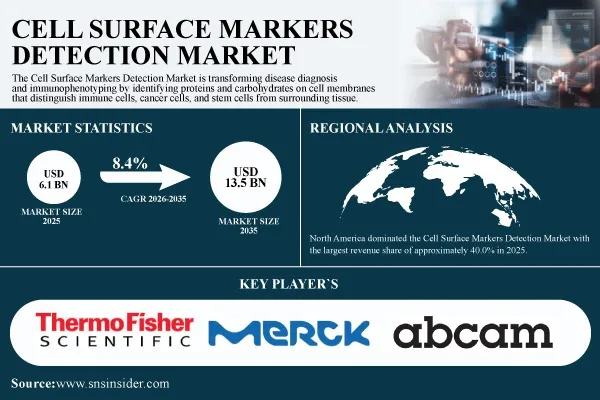
SNS Insider projects the Global Cell Surface Markers Detection Market is projected to reach USD 13.5 billion by 2035, growing at a 8.4% CAGR, while the U.S. market is projected to reach USD 4.47 billion, advancing at 8.0% CAGR, as spectral flow cytometry and multiplexed reagent platforms expand immune profiling capacity across oncology and precision diagnostics.
Austin, Texas, Sept. 22, 2026 (GLOBE NEWSWIRE) -- The global Cell Surface Markers Detection Market was valued at USD 6.1 billion in 2025 and is projected to reach USD 13.5 billion by 2035, expanding at a CAGR of 8.4% during 2026–2035. There is strong demand driven by increased usage of spectral flow cytometry, imaging flow cytometers, mass cytometers, multiplexed reagents, and automatic cell sorters.
The U.S. Cell Surface Markers Detection Market was valued at approximately USD 2.07 billion in 2025 and is projected to reach approximately USD 4.47 billion by 2035, growing at a CAGR of approximately 8.0% during 2026–2035. The growth in the region is also attributed to the prevalence of cancer, heart diseases, and neurological problems, along with the presence of research and development centers and growing demand for precise diagnostics.
Download the Cell Surface Markers Detection Market Sample Report: https://www.snsinsider.com/sample-request/11092
Europe Cell Surface Markers Detection Market was valued at USD 1.647 billion in 2025 and is projected to reach USD 3.605 billion by 2035, expanding at a CAGR of 8.15% during 2026–2035. The market for detection of cell surface markers in Europe is an important share of global market consumption because of government spending on biomedical research, use of more advanced diagnostic techniques, and the collaboration of universities with biotechnology firms.
Why this Market is Gaining Attention in 2026
Spectral Flow Cytometry is Expanding Multiparameter Cell Analysis
Detection of cell surface markers is slowly gravitating towards spectral flow cytometry as laboratories aim to detect multiple markers in each patient sample. Modern spectral instruments can detect well in excess of 40 markers at once, allowing the characterization of immune cell populations to an extent that was impossible to achieve using the previous one-at-a-time techniques.
This technology is especially pertinent to immunophenotyping, oncology, immune disorder testing, and translational research. As laboratories are trying to get more biological information from less material, multiplexing is becoming a necessity.
Imaging Integration is Creating a New Opportunity for Rare Cell Detection
The inclusion of imaging capabilities right into the flow cytometer is adding to the analytical power of cell surface marker detection. The use of morphological imaging with multi-parameter fluorescence data will aid labs to detect rare cells along with more cellular context.
Manufacturers of instruments are now coming up with platforms that include all the features of imaging, spectral detection, automation and high throughput analysis. This could be very useful for oncology, immunology, and cell therapy research where detection and characterization of particular cell population become extremely important.
Mass Cytometry and Multiplex Platforms Expand the Precision Medicine Opportunity
Opportunities have been generated through mass cytometry and similar techniques which allow for the simultaneous analysis of multiple cell surface and intracellular markers without suffering the limitations of fluorescence overlap seen in standard flow cytometry analysis.
The increased application of this technique in the area of immuno-oncology has created new applications in high dimensional cell analysis. The use of this technology has been on the rise by pharmaceutical and biotech firms to characterize immune populations and evaluate responses to therapy among others.
Commercial Findings from the Cell Surface Markers Detection Market
Reagents and Kits Dominated and Hematology Analyzers are the Fastest-Growing Product: The market share of Reagents & Kits segment is estimated to be around 65% in 2025 driven by demand for fluorophore-conjugated antibodies, staining kits and multiplexed assays from clinical and research laboratories. The Hematology Analyzers segment is the fastest growing segment with a CAGR of 8.3% driven by demand for automation and high throughput blood cell analysis.
Disease Diagnosis Dominated and Research and Drug Discovery is the Fastest-Growing Application: Disease Diagnosis and Identification comprised roughly 52% of the market in 2025 due to extensive usage of immunophenotyping in hematological cancers, autoimmune and infectious disease. Research and Drug Discovery represents the fastest growing application segment with a CAGR of 9.6% due to adoption by pharma/biotech firms of multiplexing detection techniques in immunotherapy, cellular therapy and translational medicine.
Flow Cytometry Dominated and Mass Cytometry is the Fastest-Growing Technology: The Flow Cytometry Segment held a share of about 48% in 2025 owing to the already established presence in diagnostic and research labs. The Mass Cytometry/CyTOF/Multiplex Platforms is the highest growing segment in the market with CAGR of about 10.2% due to rising demand for high dimensional immune profiling and multiple markers detection.
Hospitals & Diagnostic Laboratories Dominated and Pharmaceutical & Biotechnology Companies are the Fastest-Growing End User: Hospitals & Diagnostic Laboratories contributed 46% towards market share in 2025 owing to increased testing procedures related to cancer, immune disorder analysis, and disease infections. The segment of Pharmaceutical & Biotechnology Companies is the fastest-growing end-users, registering a CAGR of 9.8%. This growth can be attributed to cellular profiling being increasingly incorporated in immuno-oncology and cell therapy programs.
Regional Biomedical Investment is Reshaping Cell Surface Marker Detection Demand: North America held around 40.0% market share of the Global Cell Surface Markers Detection Market in 2025 owing to its developed health care system, high R&D spends, and presence of many biopharmaceutical firms, academic medical centers and diagnostic laboratories. The Asia Pacific region is projected to experience the highest CAGR of about 9.0% over 2026-2035 due to growing biotechnology industries, higher R&D spends, and investments in pharmaceutical and lab facilities.
Download Sample Report: https://www.snsinsider.com/sample-request/11092
Who Should be Watching the Cell Surface Markers Detection Market?
The market is increasingly relevant across the broader diagnostics, biotechnology and pharmaceutical research ecosystem, including:
Diagnostic laboratories → hospitals → academic research institutes → biotechnology companies → pharmaceutical companies → immuno-oncology developers → cell therapy developers → cytometry instrument manufacturers → reagent suppliers → precision medicine providers
As the possibilities for technology and reagent suppliers reach further than the realm of traditional flow cytometry, competitive differentiation is becoming more dependent on multiplexing capabilities, spectral detection, imaging integration, automation, and the ability to validate reagent panels that support high-dimensional cell analysis. In the context of pharmaceutical and biotech organizations, high-throughput cell surface marker analysis can be valuable for drug discovery, immune phenotyping, biomarker discovery, and treatment response assessment.
Platform Innovation and Multiplex Detection Expansion Shape the 2026 Market
As demand for higher-dimensional cellular analysis increases, instrument and reagent manufacturers are expanding imaging-integrated platforms and multiplexed detection capabilities across research and clinical applications.
- In 2025, Thermo Fisher Scientific continued advancing its Attune CytPix flow cytometer portfolio, integrating imaging capabilities to improve cell surface marker visualization alongside conventional fluorescence detection.
- In 2025, Beckman Coulter Life Sciences, part of Danaher, expanded its CytoFLEX flow cytometer portfolio with new reagent panels designed to improve multiplexed cell surface marker detection in oncology research applications.
Market Challenge: Managing High Instrument Costs and Specialized Workforce Requirements
High-end flow cytometry and mass cytometry technologies involve significant capital expenditure, which makes their implementation difficult for smaller diagnostic labs and research institutes that have low budgets to invest in such equipment. This has resulted in the presence of advanced cell-surface marker-detection capabilities in only a few well-financed academic medical centers and large drug companies.
There is a scarcity of skilled people who can work with such advanced cytometry technologies and analyze high dimensional data. With the emergence of more complex biological datasets with spectral and mass cytometry, there is a need for specially trained staff members who can understand such datasets and interpret results from them.
Key Competitors in the Market
Companies covered in the Cell Surface Markers Detection Market research include Thermo Fisher Scientific Inc., Becton, Dickinson and Company (BD), Danaher Corporation (Beckman Coulter, Cytiva), Cytek Biosciences, Inc., Bio-Rad Laboratories, Inc., Miltenyi Biotec B.V. & Co. KG, Standard BioTools Inc., Agilent Technologies, Inc., Merck KGaA, Bio-Techne Corporation, Sony Biotechnology Inc., DiaSorin S.p.A. (Luminex), Sysmex Corporation, Abcam plc, Cell Signaling Technology, Inc., Revvity, Inc. (PerkinElmer), Illumina, Inc., 10x Genomics, Inc., Exalpha Biologicals, Inc., and BioLegend, Inc.
Buy the Cell Surface Markers Detection Market Report with Competitive Analysis at a 20% Discount: https://www.snsinsider.com/checkout/11092
CONTACT: About Us:
SNS Insider is one of the leading market research and consulting agencies that dominates the market research industry globally. Our company's aim is to give clients the knowledge they require in order to function in changing circumstances. In order to give you current, accurate market data, consumer insights, and opinions so that you can make decisions with confidence, we employ a variety of techniques, including surveys, video talks, and focus groups around the world.

Contact Us:
Rohan Jadhav - Principal Consultant
Phone: +1-315-961-9094 (US)
Email: info@snsinsider.com


Comments (0)
Login to join the conversation
Login / RegisterNo comments yet. Be the first to comment!