
U.S. High Content Screening Market to Reach USD 1.22 Billion and Europe USD 0.97 Billion by 2035, Supported by AI-Powered Image Analysis, 3D Cell Culture, Phenotypic Screening and CRO Adoption.
Austin, United States, Sept. 08, 2026 (GLOBE NEWSWIRE) -- High Content Screening Market Size & Growth Analysis:
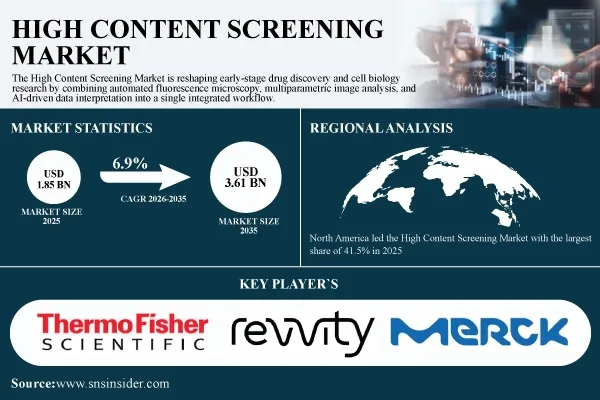
According to SNS Insider, The High Content Screening Market size was valued at USD 1.85 Billion in 2025 and is expected to reach USD 3.61 Billion by 2035, growing at a CAGR of 6.9% from 2026 to 2035. Demand is rising as automated fluorescence microscopy, multiparametric image analysis, and AI-driven data interpretation converge into a single integrated workflow reshaping early-stage drug discovery and cell biology research. Rising adoption of phenotypic screening across oncology, neuroscience, and toxicology programs, growing use of three-dimensional cell models such as organoids and spheroids, and deeper AI integration into image classification software continue to expand the high content screening market.
Confocal and spinning-disk imaging platforms, cloud-connected analytics, and CRO-led screening services are playing an important role in high content screening market modernization, as pharmaceutical companies, biotechnology firms, and academic research institutes invest in automated, high-throughput imaging infrastructure that shortens preclinical timelines.
Download the High Content Screening Market Sample Report: https://www.snsinsider.com/sample-request/10783
High Content Screening Market Key Highlights
- Market size, 2025: USD 1.85 Billion
- Market size, 2026E: USD 1.98 Billion
- Market forecast, 2035: USD 3.61 Billion
- CAGR: 6.9% from 2026 to 2035
- Largest region: North America, approximately 41.5% share in 2025
- Fastest-growing region: Asia Pacific, approximately 8.7% CAGR
- Largest product: Instruments, approximately 43% share in 2025
- Fastest-growing product: Software
- Largest technology: 2D Cell Culture-based HCS, approximately 54% share in 2025
- Fastest-growing technology: 3D Cell Culture-based HCS
- Largest application: Drug Discovery & Development, approximately 47% share in 2025
- Fastest-growing application: Phenotypic, Stem Cell & Cancer Research
- Largest end-user: Pharmaceutical & Biotechnology Companies, approximately 50% share in 2025
- Fastest-growing end-user: Contract Research Organizations (CROs)
Market Relevance
High content screening has become an integral part of contemporary drug discovery, as it combines automated imaging with AI-driven analysis to extract deeper biological insight from compound libraries at scale. Rising phenotypic screening adoption across oncology, neuroscience, and toxicology, alongside growing use of physiologically relevant 3D cell models, is reinforcing the technology's role well beyond its original pharmaceutical-screening use case.
High Content Screening Market Overview
The market comprises imaging instruments and analysis software used across 2D and 3D cell culture-based screening technologies, applied to drug discovery, phenotypic research, and cancer and stem cell studies across pharmaceutical companies, academic institutions, and contract research organizations. Confocal and spinning-disk imagers, robotic plate handlers, and AI-integrated camera systems continue to anchor instrument demand, while cloud-connected analytics and subscription-based data management platforms are extending the useful life of existing hardware.
Strategic Market Outlook
Opportunities for growth lie in three-dimensional organoid and organ-on-chip screening, as pharmaceutical companies increasingly seek physiologically relevant preclinical models that better predict human drug response and reduce late-stage clinical trial failure. Closing research infrastructure gaps across emerging pharmaceutical markets presents a further opportunity, as governments build domestic biotechnology innovation capacity.
High instrument costs and data management complexity remain major constraints. Advanced confocal and spinning-disk imaging instrumentation requires substantial capital investment that smaller academic laboratories and early-stage biotechnology firms often cannot commit, while storing, curating, and analyzing large, multi-terabyte imaging datasets requires ongoing informatics investment that keeps some smaller organizations reliant on outsourced screening services.
High Content Screening Market Regional Analysis
North America held approximately 41.5% of the global market in 2025, making it the largest region, supported by strong pharmaceutical and biotechnology R&D spending, a dense concentration of contract research organizations, and sustained National Institutes of Health and Department of Defense funding for translational research. The United States accounted for approximately 84.20% of North American revenue, anchored by a dense cluster of pharmaceutical companies and well-funded biotechnology startups, while Canada contributes through its own growing biotechnology sector and government-backed genomics initiatives.
The U.S. High Content Screening Market was valued at approximately USD 0.65 Billion in 2025 and is expected to reach approximately USD 1.22 Billion by 2035, growing at a CAGR of approximately 6.5% from 2026 to 2035.
The Europe High Content Screening Market held approximately 28% of the global market in 2025, valued at USD 0.52 Billion, and is expected to reach USD 0.97 Billion by 2035, growing at a CAGR of 6.50% from 2026 to 2035. Growth is supported by substantial European Research Council funding for translational research and precision oncology programs. Germany led demand at approximately 23.40% of European revenue in 2025, supported by its substantial pharmaceutical and academic research base, while the U.K. and France contribute through well-funded biotechnology clusters.
The Asia-Pacific region is the fastest-growing, with a projected CAGR of approximately 8.7% from 2026 to 2035, driven by rapid expansion of domestic pharmaceutical and biotechnology manufacturing capacity. China led regional revenue, supported by substantial government investment in domestic biotechnology innovation, while Japan and India contribute through advanced pharmaceutical manufacturing and a fast-growing contract research sector respectively.
Buy the High Content Screening Market Report with Competitive Analysis and 2035 Forecast: https://www.snsinsider.com/checkout/10783
High Content Screening Market Segment Analysis
By Product: Instruments accounted for around 43% market share in 2025, driven by sustained capital investment in automated fluorescence microscopes, confocal and spinning-disk imagers, and robotic plate handlers. Software is the fastest-growing segment, driven by rising demand for AI-powered image classification and cloud-connected analytics that extend the useful life of existing imaging hardware.
By Technology: 2D Cell Culture-based HCS accounted for around 54% market share in 2025, supported by established assay protocols, lower per-well reagent costs, and broad compatibility with existing infrastructure. 3D Cell Culture-based HCS is the fastest-growing technology, driven by rising adoption of organoid, spheroid, and organ-on-chip models that better replicate human tissue architecture.
By Application: Drug Discovery & Development accounted for around 47% market share in 2025, given the central role phenotypic imaging plays in hit identification and lead optimization. Phenotypic, Stem Cell & Cancer Research is the fastest-growing application, driven by rising government and foundation funding for precision oncology and regenerative medicine research.
By End-User: Pharmaceutical & Biotechnology Companies accounted for around 50% market share in 2025, supported by direct control over early-stage research pipelines and substantial internal screening infrastructure investment. Contract Research Organizations are the fastest-growing segment, as smaller biotechnology firms increasingly outsource phenotypic screening campaigns.
High Content Screening Market Key Trends
- Growing integration of artificial intelligence improving the speed and accuracy of phenotypic image analysis
- Rising adoption of three-dimensional organoid and spheroid models expanding assay biological relevance
- Increasing use of high-content screening in toxicology supporting earlier compound attrition decisions
- Expanding CRO-led screening services giving smaller biotech firms access to advanced imaging infrastructure
- Growing deployment of cloud-connected analytics software extending the productive life of imaging hardware
Major key players include
- Thermo Fisher Scientific Inc.
- Danaher Corporation
- Revvity, Inc.
- Merck KGaA
- Becton, Dickinson and Company
- Sartorius AG
- Yokogawa Electric Corporation
- Agilent Technologies, Inc.
- Bio-Rad Laboratories, Inc.
- Bruker Corporation
- Tecan Group Ltd.
- Corning Incorporated
- Evident Corporation
- Nikon Corporation
- Carl Zeiss AG
- Molecular Devices, LLC
- Genedata AG
- SPT Labtech Ltd.
- IDEA Bio-Medical Ltd.
- Vala Sciences, Inc.
Explore the Complete High Content Screening Market Report: https://www.snsinsider.com/reports/high-content-screening-market-10783
CONTACT: About Us:
SNS Insider is one of the leading market research and consulting agencies that dominates the market research industry globally. Our company's aim is to give clients the knowledge they require in order to function in changing circumstances. In order to give you current, accurate market data, consumer insights, and opinions so that you can make decisions with confidence, we employ a variety of techniques, including surveys, video talks, and focus groups around the world.

Contact Us:
Rohan Jadhav - Principal Consultant
Phone: +1-315-961-9094 (US)
Email: info@snsinsider.com


Comments (0)
Login to join the conversation
Login / RegisterNo comments yet. Be the first to comment!