
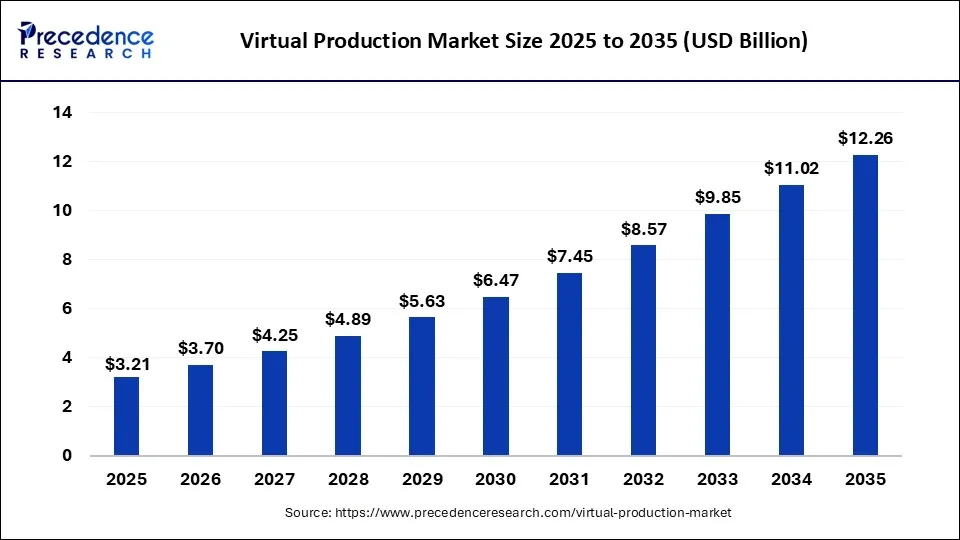
According to Precedence Research, the global virtual production market was valued at USD 3.21 billion in 2025 and is forecast to reach USD 12.26 billion by 2035. The market is projected to expand from USD 3.70 billion in 2026, reflecting a 14.34% CAGR over 2026-2035.
Ottawa, Oct. 14, 2026 (GLOBE NEWSWIRE) -- The global virtual production market is projected to grow from USD 3.70 billion in 2026 to USD 12.26 billion by 2035, according to Precedence Research, representing a compound annual growth rate (CAGR) of 14.34% from 2026 to 2035.
Alongside this market expansion, new studio investments, acquisitions of production infrastructure, LED volume deployments and the expansion of visual effects capabilities in India and Asia are reshaping competition and creating opportunities for technology providers, studios, content producers and investors.
The virtual production industry is moving beyond its early association with premium film sets. It is increasingly becoming part of a broader production infrastructure that supports streaming series, advertising, branded content, digital entertainment and location-independent filming. The latest developments indicate two simultaneous shifts: established studios are expanding or consolidating production capabilities, while display manufacturers and software developers are competing to make real-time production more accessible.
The market opportunity therefore extends beyond LED walls. It includes rendering software, camera tracking, content creation, virtual set design, production services, workflow integration and the skilled workforce required to operate these systems.
Market size and growth outlook
- 2025 market size: $3.21B
- 2035 forecast: $12.26B
- 2026 market estimate: $3.70B
- 2026-2035 CAGR: 14.34%
The forecast implies an expansion of approximately USD 9.05 billion between 2025 and 2035. That growth reflects a structural change in how visual content is planned and produced: more production decisions are being made in real time, environments can be altered digitally, and production teams can combine physical performances with computer-generated scenes before footage reaches conventional post-production.
Market estimates from different research providers are not directly interchangeable because they can use different definitions, revenue boundaries, base years and forecast periods. The figures below use Precedence Research as the primary source for the market outlook.
| Market indicator | Precedence Research estimate | |
| Global market, 2026 | USD 3.70 billion | |
| Global market, 2035 | USD 12.26 billion | |
| CAGR, 2026–2035 | 14.34% | |
| North America share, 2025 | 36% | |
| Software share, 2025 | 46% | |
| Pre-production share, 2025 | More than 51% | |
| Leading end-user category, 2025 | TV series | |
These figures suggest that software and pre-production are already central to the industry. They also show why competitive analysis must cover the entire workflow rather than focusing only on physical production stages.
Purchase options: Checkout Virtual Production Market Size to Hit USD 12.26 Bn by 2035
Latest industry news: company investments and competitive developments
Recent company announcements provide a clearer view of where the market is heading. Studio expansions and acquisitions are creating additional production capacity, while manufacturers and technology providers are building the hardware and software infrastructure needed to support these facilities.
Dark Slope acquires Pixomondo virtual production assets
On September 29, 2026, Toronto-based Dark Slope announced that it had acquired virtual production assets from Pixomondo, including selected assets from Pixomondo’s Vancouver operation. Dark Slope said the acquisition would strengthen its ability to deliver large-scale virtual production across Canada.
The company already operates a 75,000 square-foot production campus in Toronto. The additional equipment and infrastructure will allow it to develop and deploy custom LED volumes for productions of different sizes, both at its studios and on location. Dark Slope also indicated plans to open a new Vancouver studio.
The development is commercially significant for three reasons.
First, it illustrates how existing production assets can be consolidated rather than requiring every studio to build all capabilities from scratch. Second, it expands the ability to serve productions that need flexible stage configurations. Third, it suggests that competition is increasingly about production readiness, technical expertise and the ability to deploy infrastructure where customers need it.
For LED display vendors, tracking-system suppliers and production service providers, acquisitions can change which organizations control equipment and how future projects are awarded. For buyers, expanded capacity may provide more options for complex productions, although availability, pricing and location remain important considerations.
Schedule a discussion: Schedule a meeting with Precedence Research
Netflix expands Eyeline Studios in Hyderabad
On March 12, 2026, Netflix announced the opening of its Eyeline Studios facility in Hyderabad, India. The 32,000-square-foot location adds to Eyeline’s global network, which includes Los Angeles, Vancouver, Seoul and London.
The Hyderabad facility is designed to support advanced visual effects, generative visual effects and production workflows supported by hybrid cloud infrastructure. Netflix described the investment as part of its longer-term commitment to India’s animation, visual effects, gaming and comics ecosystem.
The announcement matters to the virtual production market because it strengthens the connection between global content production and India’s technology and creative talent base. While a VFX and production innovation facility is not the same as a dedicated LED-volume stage, its capabilities can complement virtual production pipelines through asset creation, digital environments and post-production integration.
Potential beneficiaries include software vendors, production technology integrators, training providers, visual-effects businesses and talent-development organizations. The opportunity for Indian suppliers is to move beyond labour-intensive execution toward higher-value technical services, workflow design and specialized production capabilities.
LED manufacturers expand production infrastructure in Asia and Europe
AOTO’s 2026 industry announcements have highlighted further virtual production activity. The company reported support for a new 5,000-square-metre virtual production facility at Chengdu Film City VP Studio in China, alongside projects intended to expand its presence in European virtual production studios.
The commercial significance is broader than the installation of display panels. As facilities grow, demand can increase for high-resolution LED screens, processing systems, colour management, camera integration, calibration, installation and ongoing technical support.
For customers, the purchasing decision is not simply about display specifications. A virtual production installation must work with camera sensors, lenses, tracking systems, lighting conditions, rendering software and the production team’s workflow. The quality of integration can determine whether a stage delivers consistent results under real filming conditions.
Manufacturers that can demonstrate dependable performance, service support and compatibility with other systems may be better positioned to win projects. Studio operators, meanwhile, must evaluate the total cost of ownership rather than the purchase price of the display alone.
Production investment spreads into commercial content
THG Studios announced a seven-figure investment in virtual production technology in July 2025. The company positioned the capability as a way to help brands create television-quality content with greater flexibility and potential time and cost efficiencies.
LG Electronics USA also announced an in-house virtual production studio at its New Jersey headquarters in February 2025. The facility integrates LG’s commercial LED display technology with camera tracking and LED-processing technologies.
These examples show that adoption is not limited to feature films and high-budget television. Brands can use virtual production to create product scenes, campaigns and multiple variations of marketing content without rebuilding every physical location.
The business case can be particularly attractive where a company needs recurring product imagery, geographically varied backgrounds, rapid campaign updates or consistent visual presentation across multiple channels. However, the financial benefit depends on how frequently the stage is used, the complexity of the production and the cost of developing digital environments.
| Company or organization | Development | Market implication |
| Dark Slope | Acquisition of Pixomondo virtual production assets, September 2026 | Expanded Canadian production capacity and more flexible LED volume deployment |
| Netflix / Eyeline Studios | Hyderabad facility opened in March 2026 | Stronger integration of Indian talent and production technology into global pipelines |
| AOTO | Virtual production facility and studio projects highlighted in 2026 | Growing demand for LED display systems and integrated studio infrastructure |
| THG Studios | Seven-figure virtual production investment announced in July 2025 | Wider use of virtual production in branded and commercial content |
| LG Electronics USA | In-house virtual production studio announced in February 2025 | Demonstration of enterprise-led, internal content production |
These announcements are evidence of strategic activity, not a complete census of the market. They do not, by themselves, establish market share or prove that every investment will generate a positive return.
What is driving market expansion?
Real-time rendering and software integration
Software accounted for 46% of the virtual production market in 2025, according to Precedence Research. Software platforms are central to the creation of digital environments, real-time rendering, scene management, camera calibration and collaboration between creative and technical teams.
Companies such as Epic Games, NVIDIA, Autodesk, Adobe and SideFX participate in different parts of the wider content creation and visual production ecosystem. Their products and workflows can help teams build digital assets, render scenes, manage 3D content and prepare material for production.
The competitive opportunity is increasingly tied to interoperability. A studio may have premium LED displays but still experience delays if its tracking system, rendering pipeline and creative tools do not work smoothly together. Software that reduces setup time, improves reliability and enables reuse of digital assets can deliver value across multiple projects.
Greater flexibility in production planning
Pre-production represented more than 51% of the virtual production market in 2025, according to Precedence Research. This underlines the value of planning and visualizing scenes before filming begins.
Virtual scouting, digital set design, previsualization and real-time scene testing can help creative teams assess camera angles, lighting, composition and movement before committing to expensive physical production decisions. When integrated into the workflow, this can reduce uncertainty and improve coordination between directors, cinematographers, visual-effects teams and production managers.
The value is greatest when the digital planning work is reused during actual production. Creating a digital environment that is never used beyond an early concept stage may add cost rather than reduce it.
Demand from television and streaming
TV series were the leading end-user category in the Precedence Research market assessment for 2025. Episodic production can benefit from reusable environments, recurring locations and consistent visual styles across multiple episodes.
A digital set may be adapted for different scenes without requiring a complete physical rebuild. Productions can also combine in-camera environments with conventional VFX where each approach is most suitable.
Nevertheless, virtual production does not eliminate every location shoot or post-production requirement. Its value depends on the narrative, visual style, camera movement, actor blocking, stage dimensions and the level of realism required.
New opportunities in advertising and branded content
Commercial advertising is an important potential growth area because marketing teams often need multiple creative variations within compressed schedules. Virtual environments can support different locations, lighting conditions, seasons and product presentations in a controlled studio setting.
The approach can also help brands maintain visual consistency across markets. However, successful adoption requires a production pipeline that makes asset preparation and revision economical. If every campaign requires extensive custom development, savings may be limited.
Market segmentation and competitive positioning
The market includes software, hardware and services, while production workflows span pre-production, production and post-production. Each segment has a different commercial model and set of buying criteria.
| Segment | Core offerings | Buyer priorities | Competitive opportunity |
| Software | Rendering, virtual environments, scene design and workflow tools | Reliability, interoperability and speed | Recurring software revenue and workflow integration |
| Hardware | LED displays, cameras, tracking and processing systems | Image quality, latency, calibration and support | Integrated systems and lower total cost of ownership |
| Services | Stage operation, technical integration, production support and consulting | Experienced crews, availability and delivery certainty | Managed production and flexible access to facilities |
| Pre-production | Virtual scouting, previs and digital asset preparation | Creative alignment and reuse of assets | Fewer production changes and more efficient planning |
| Production | Real-time filming and in-camera visual effects | Image quality, tracking precision and stage reliability | Faster execution and controlled environments |
| Post-production | Editing, VFX, compositing and finishing | Quality, compatibility and turnaround time | Hybrid pipelines and efficient finishing workflows |
The strongest commercial positions may emerge where suppliers can connect multiple stages of the workflow. A hardware supplier that also supports integration, calibration and service can be more valuable to a buyer than a vendor selling a component in isolation. Similarly, software providers can differentiate themselves through compatibility, production-ready tools and reduced technical friction.
Regional outlook: established production centres and emerging hubs
North America held a 36% share of the global virtual production market in 2025, according to Precedence Research. The region benefits from established film and television production ecosystems, technology companies, studio infrastructure and experienced crews.
Asia Pacific is projected to be the fastest-growing region. Investment in production infrastructure, digital content, display manufacturing and creative technology can support demand across China, India, Japan, South Korea and other markets. Recent developments in Hyderabad and Chengdu illustrate different sides of this expansion: one strengthens the integration of talent and global production pipelines, while the other highlights infrastructure investment.
Europe remains relevant through established film centres, studio operators and display technology partnerships. Its competitive position depends on local production demand, available facilities, technical skills and the economics of cross-border projects.
| Region | Competitive strengths | Opportunities | Key considerations |
| North America | Established film and streaming ecosystem, technology providers and experienced production teams | High-end studio projects, software and integrated production services | Infrastructure utilization and production budgets |
| Asia Pacific | Growing content industries, display manufacturing and expanding technical talent | New stages, local-language content and production services | Skills development, workflow compatibility and sustained demand |
| Europe | Established production hubs and specialist technology providers | Commercial content, studio partnerships and cross-border productions | Investment costs, facility utilization and access to expertise |
| Latin America | Film, television, advertising and regional content opportunities | Flexible production services and localized content | Capital availability and specialist infrastructure |
| Middle East and Africa | Emerging production initiatives and investment in creative industries | New studio infrastructure and regional production services | Talent pipelines, demand development and long-term operating economics |
The regional opportunity should not be judged solely by the number of new facilities. Utilization, project pipelines, local skills and the ability to attract repeat production work are equally important indicators of commercial sustainability.
Risks and challenges investors and buyers should monitor
Virtual production can improve flexibility, but it also introduces capital and operational requirements. Large LED installations, rendering infrastructure, tracking systems and studio integration can require substantial upfront expenditure. Underused facilities may struggle to recover those costs.
Technical complexity is another constraint. Camera tracking, colour reproduction, moiré management, frame synchronization and lighting integration must all perform reliably. Problems can create delays that offset the expected efficiencies.
There is also a skills challenge. Successful projects require coordination between cinematography, lighting, game-engine workflows, visual effects and stage operations. Buying technology without investing in personnel and repeatable processes may produce disappointing results.
Finally, market growth is not distributed evenly. Premium film and television productions may justify advanced facilities, while smaller advertising teams may prefer rental services, compact installations or outsourced production. Suppliers must match their investment and pricing models to the customers they serve.
Strategic outlook: where the next opportunities may emerge
The market's next phase is likely to be shaped by five developments:
- Flexible production infrastructure: Mobile or configurable LED volumes can serve productions that do not fit a fixed-stage model.
- Software-led workflow improvement: Better interoperability and more reusable digital assets can reduce production friction.
- Expansion into commercial content: Brands and enterprise marketing teams may use virtual production for repeatable campaigns and product content.
- Regional capacity development: India and other Asia Pacific markets can deepen their roles in digital production, visual effects and creative technology.
- Consolidation and partnerships: Acquisitions and collaborations can bring equipment, talent and studio capabilities together, helping providers serve larger or more varied projects.
For decision-makers, the most useful indicators to monitor include new facility openings, acquisition activity, technology partnerships, stage utilization, recurring commercial customers and the adoption of integrated software workflows. These indicators provide a more practical view of competitive momentum than headline market growth alone.
How Precedence Research supports virtual production decisions
Precedence Research helps companies assess market opportunities, evaluate competitors and identify where investment or product development may be commercially attractive. Its virtual production research can be complemented by tailored intelligence based on a buyer's geography, technology focus, customer segment and strategic objectives.
- Master Dataset: Structured market data for modelling, planning, scenario analysis and internal reporting.
- Precedence Quadrant: Comparative company mapping to help assess competitor positioning and identify potential partners or emerging challengers.
- Interactive Dashboard: A more accessible view of market and segment information for monitoring trends and supporting internal decisions.
- Customized Research: Focused analysis of regional opportunities, customer demand, competitive activity, emerging applications and specific strategic questions.
- Quality & Manufacturing Intelligence: Where relevant to display and production-equipment suppliers, analysis of manufacturing capabilities, product quality, supply considerations and competitive positioning.
Research can be updated on a monthly, quarterly, six-monthly or yearly basis, depending on the client's needs and selected scope. Companies can use these deliverables to assess market entry, evaluate investment priorities, identify potential partners, benchmark competitors or prepare commercial expansion plans.
To explore the underlying market estimates and report scope, visit the Virtual Production Market report.
Related reports
- Digital Content Creation Market
- Visual Effects (VFX) Market
- Animation Market
- Augmented Reality Market
- Virtual Reality Market
- Augmented Reality and Virtual Reality Market
- Media and Entertainment Market
- 3D Rendering Market
- Computer Graphics Market
- Artificial Intelligence in Media and Entertainment Market
About Precedence Research
Precedence Research provides market intelligence and consulting support to businesses, investors and strategy teams. Its research covers market sizing, growth forecasts, competitive landscapes, regional opportunities and industry trends across a wide range of sectors.
Its offerings include market research reports, datasets, company intelligence, competitive positioning, interactive dashboards and customized research. These services help organizations evaluate opportunities, monitor market changes and support strategic, commercial and investment decisions.
Our partner platforms
- Towards Healthcare: https://www.towardshealthcare.com/
- Towards Packaging: https://www.towardspackaging.com/
- Towards Chemical & Materials: https://www.towardschemandmaterials.com/
Connect With Us
- USA: +1 804 441 9344
- APAC: +61 485 981 310
- India: +91 87933 22019
- Singapore: +65 3105 1271
- Europe: +44 7383 092 044
- Email: sales@precedenceresearch.com
Follow Precedence Research








Comments (0)
Login to join the conversation
Login / RegisterNo comments yet. Be the first to comment!