
Clinical Trial Supply and Logistics Market Intelligence: Logistics and Distribution Held 28% Share in 2023 as Asia-Pacific Emerges as a Growth Opportunity, a study by Towards Healthcare sister firm of Precedence Research
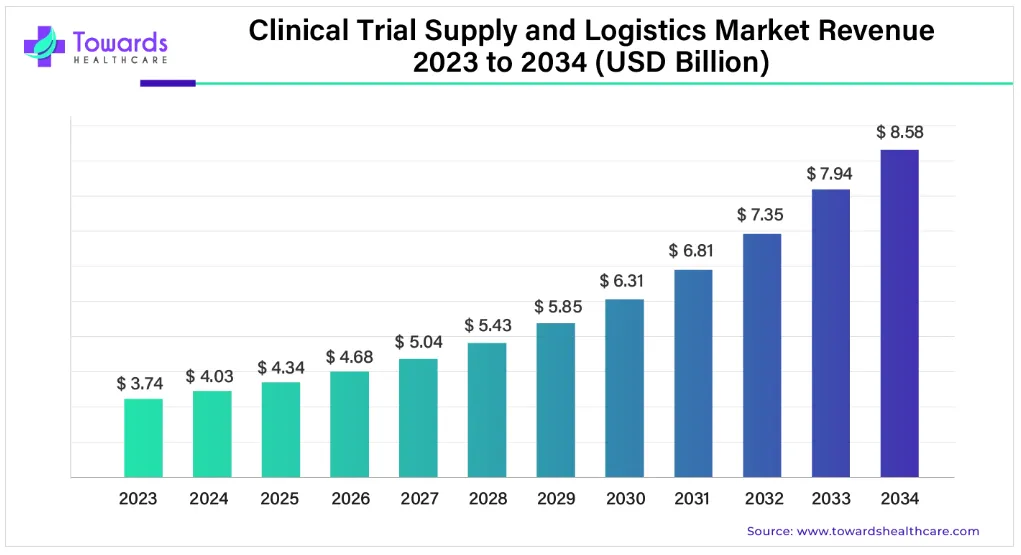
Ottawa, Oct. 28, 2026 (GLOBE NEWSWIRE) -- The global clinical trial supply and logistics market is projected to grow from USD 3.74 billion in 2023 to USD 8.58 billion by 2034, expanding at a CAGR of 7.63% from 2024 to 2034. North America accounted for 39% of the market in 2023, while logistics and distribution represented 28% of service revenue.
Download a sample of the Clinical Trial Supply and Logistics Market report to review the market forecast, segment analysis, regional outlook, and competitive landscape @ https://www.towardshealthcare.com/download-sample/5226
The global clinical trial supply and logistics market is entering a strategically important period as pharmaceutical and biotechnology companies expand clinical development programs, advance complex biologics and cell and gene therapies, and seek more reliable ways to deliver investigational products across geographically dispersed trial networks. These requirements are increasing the importance of specialized logistics, temperature-controlled storage, clinical supply planning, packaging and labeling, comparator sourcing, and end-to-end inventory visibility.
For sponsors, contract research organizations (CROs), contract development and manufacturing organizations (CDMOs), and logistics providers, the commercial opportunity extends beyond transporting investigational medicines. It increasingly involves coordinating product availability, trial-site readiness, packaging compliance, temperature monitoring, demand forecasting, and delivery schedules across the clinical development lifecycle.
Towards Healthcare’s market research and consulting solutions are designed to help organizations assess this evolving market, benchmark competitors, identify regional opportunities, evaluate supplier capabilities, and make evidence-led decisions about service expansion, partnerships, and investment.
Clinical Trial Supply and Logistics Market: Key Data and Forecast
The market is supported by growing pharmaceutical research and development, rising demand for biologics, expanding clinical-trial activity, and the operational complexity associated with moving investigational products between manufacturers, depots, clinical sites, laboratories, and in appropriate study models patients.
Key market indicators from Towards Healthcare’s analysis include:
- Market size in 2023: USD 3.74 billion.
- Forecast market size in 2034: USD 8.58 billion.
- Forecast CAGR, 2024–2034: 7.63%.
- Leading region in 2023: North America, with a 39% share.
- Leading service segment in 2023: Logistics and distribution, with a 28% share.
- Manufacturing service opportunity: The manufacturing segment accounted for 22% of the market in 2023 and is identified as an important area for growth.
- Leading clinical-trial phase in 2023: Phase III, with a 41% share.
- Phase II outlook: Phase II accounted for 21% in 2023 and is projected to expand at a comparatively faster rate.
- Leading therapeutic area in 2023: Cardiovascular disorders, with a 31% share.
- Oncology opportunity: Oncology accounted for 25% in 2023 and is identified as a significant growth area.
- Leading end-use category in 2023: Pharmaceuticals, with a 42% share.
- Biologicals opportunity: Biologicals accounted for 35% in 2023 and are expected to gain importance over the forecast period.
These figures describe the market structure reported for 2023 and the forecast period specified above. They should not be interpreted as 2026 market shares or as a separate 2025 - 2035 forecast.
The strategic implication is that market growth will not be uniform across every service, therapy, trial phase, or geography. Companies need to distinguish established revenue pools from segments where increasing product complexity, specialist infrastructure, or unmet operational requirements may create new commercial opportunities.
Schedule a meeting with our expert team to discuss your clinical trial supply and logistics research requirements, competitive priorities, or market-entry plans @ https://www.towardshealthcare.com/schedule-meeting
Why Clinical Trial Supply Chains Are Becoming More Strategic
Increasing complexity of clinical development
Clinical supply operations must align with trial protocols, recruitment rates, manufacturing schedules, expiry dates, country-specific requirements, and site-level inventory needs. A delay in one component can affect several downstream activities, including site activation, patient dosing, protocol execution, and trial timelines.
As a result, sponsors increasingly need supply-chain partners that can coordinate planning and execution rather than simply provide transportation. Service differentiation can come from reliable forecasting, contingency planning, visibility across depots, responsive site support, and the ability to manage supply changes as a study evolves.
Business implication: Providers that can demonstrate measurable improvements in delivery reliability, inventory control, and operational coordination may be better positioned to compete for complex, multi-country studies.
Biologics and advanced therapies increase handling requirements
Biologics and other temperature-sensitive investigational products may require validated storage and transport conditions, specialized packaging, documented handling procedures, and continuous temperature monitoring. Certain cell and gene therapy programs can involve particularly demanding logistics, including time-sensitive movement of biological materials, specialized storage, and coordination between collection, manufacturing, and treatment locations.
These requirements create opportunities for specialist couriers, temperature-controlled storage operators, packaging providers, and integrated clinical supply partners. They also raise the cost of operational failure: a shipment excursion or missed delivery can lead to product loss, replacement costs, protocol disruption, or patient rescheduling.
Business implication: Buyers need to assess providers by their validated capabilities, geographic coverage, product-handling expertise, contingency procedures, and quality systems not solely by freight price.
Decentralized and hybrid trials reshape delivery models
Hybrid and decentralized clinical trials can change how investigational products and supporting materials reach participants. Depending on the protocol and applicable rules, supply may need to move beyond conventional site-based distribution to include home delivery, local pharmacy networks, remote-care providers, or other patient-centric arrangements.
This creates additional requirements for shipment scheduling, identity and delivery verification, returns management, patient privacy, inventory visibility, and coordination between sponsors, sites, pharmacies, and logistics partners.
The opportunity is not simply to extend conventional distribution to more addresses. Providers must design operating models around the specific study protocol and local regulatory requirements, while maintaining traceability and appropriate product controls.
Digital supply planning and real-time visibility gain importance
Digital tools can connect trial supply forecasts, recruitment information, inventory records, depot operations, shipment status, and temperature-monitoring data. Predictive analytics can help teams identify potential shortages, adjust resupply quantities, and plan around changes in recruitment or study design.
However, technology creates value only when the underlying data are reliable and systems can exchange information effectively. Fragmented records, inconsistent processes, limited interoperability, and unclear ownership of supply decisions can undermine even sophisticated forecasting tools.
Business implication: Sponsors and service providers should evaluate digital platforms against practical outcomes, including fewer stockouts, less expiry-related waste, faster exception resolution, improved inventory utilization, and more dependable site-level supply.
Market Segmentation: Where the Commercial Opportunities Are Emerging
Logistics and distribution remain central to market activity
Logistics and distribution held a 28% share of the clinical trial supply and logistics market in 2023, making it the leading service segment in Towards Healthcare’s analysis. Its role includes coordinating specialized transportation, storage, shipment execution, and distribution to trial locations.
Demand is shaped by geographic reach, service reliability, temperature-control capabilities, shipment visibility, and the ability to respond to changing trial requirements. For buyers, the relevant question is whether a provider can support the required countries, product types, delivery windows, and service levels throughout a trial.
Manufacturing and packaging create complementary opportunities
Manufacturing represented 22% of the market in 2023 and is identified as an important growth area. Clinical supply manufacturing and preparation can involve investigational-product production, packaging, labeling, blinding, kitting, quality checks, and coordination with distribution partners.
Sponsors may outsource these activities to specialized providers when they lack internal capacity or need to accelerate execution across several studies. Providers that can coordinate manufacturing, packaging, documentation, and downstream distribution may offer operational advantages, particularly where study timelines are demanding.
Other relevant service categories include storage and retention, packaging and labeling, blinding, comparator sourcing, and related services.
Phase III programs create scale and coordination demands
Phase III trials represented 41% of the market in 2023. Large, multi-site studies can require substantial quantities of investigational products and supporting materials, as well as coordinated distribution across different countries and clinical locations.
Demand forecasting must account for enrollment patterns, site activation, protocol amendments, randomization, dosing schedules, and potential replacement shipments. Sponsors also need to manage expiry exposure and avoid excess inventory as recruitment or study timelines change.
Phase II, which accounted for 21% of the market in 2023, is projected to grow at a comparatively faster rate. As programs progress through development, supply strategies may need to evolve from smaller, more variable requirements toward broader distribution and more structured inventory planning.
Therapeutic-area demand is not uniform
Cardiovascular disorders accounted for 31% of the market in 2023, while oncology accounted for 25%. Oncology is an important opportunity area given the range of investigational medicines and treatment approaches being evaluated.
The logistics implications differ across therapeutic areas and individual protocols. A conventional oral investigational medicine may have very different storage, packaging, and delivery requirements from a biologic, radiopharmaceutical, or advanced therapy. Market participants therefore need to analyze demand by therapy, product characteristics, trial phase, and required service model rather than rely on aggregate market growth alone.
Pharmaceuticals lead, while biologicals increase the need for specialized capabilities
Pharmaceuticals represented 42% of the market in 2023. Biologicals accounted for 35% and are expected to gain importance over the forecast period.
The opportunity associated with biologicals extends beyond transport volume. Temperature-controlled storage, shipment qualification, monitoring, handling procedures, and coordinated exception management can become central components of a provider’s value proposition. Companies investing in these capabilities need to evaluate infrastructure requirements, utilization, customer demand, geographic coverage, and the economics of specialist services.
Regional Outlook: North America Leads, Asia-Pacific Offers Expansion Potential
North America
North America held a 39% market share in 2023, supported by its clinical research infrastructure, pharmaceutical and biotechnology activity, and established clinical supply service providers.
For companies operating in this region, competitive differentiation may depend on integrated service delivery, advanced-therapy capabilities, reliable distribution networks, digital visibility, and the ability to serve sponsors across multiple trial phases.
Market participants can use regional and supplier intelligence to evaluate service coverage, identify underserved locations, compare competitor offerings, and assess whether additional depot or temperature-controlled capacity aligns with expected demand.
Asia-Pacific
Asia-Pacific is projected to be the fastest-growing region in the market. Clinical research activity across countries including China, India, Japan, South Korea, Australia, and Singapore creates opportunities for logistics providers and clinical supply specialists.
Expansion decisions nevertheless require country-level analysis. Import and export procedures, local operating requirements, transport infrastructure, available storage capacity, trial-site distribution, and the presence of qualified service partners can influence the feasibility of serving a market.
Business implication: Regional growth forecasts should be translated into specific country, service, and customer opportunities before companies commit to new facilities, partnerships, or commercial expansion.
Europe
Europe remains an important market for multinational clinical development and specialized supply operations. Regulatory coordination and the requirements of trials conducted across multiple countries make accurate documentation, process consistency, and visibility important operational priorities.
The European Union’s Clinical Trials Regulation is fully applicable, with the Clinical Trials Information System (CTIS) serving as the common submission and information platform for clinical trials. Sponsors and service providers must understand the operational responsibilities relevant to their role and ensure that supply-chain processes align with the applicable trial and product requirements.
Latin America and the Middle East and Africa
Latin America and the Middle East and Africa present opportunities that depend on individual countries, therapeutic areas, trial networks, and local service capabilities. Organizations assessing these markets should evaluate cross-border shipment requirements, infrastructure availability, qualified suppliers, delivery timelines, and the feasibility of maintaining appropriate product conditions.
Rather than treating these regions as uniform markets, companies should build country-level assessments and prioritize locations where clinical activity, sponsor demand, and operational capabilities align.
Competitive Landscape: Integrated Services and Technology Are Strategic Differentiators
The competitive landscape includes specialist clinical supply providers, global logistics companies, clinical research service organizations, CDMOs, and technology vendors. Companies identified in Towards Healthcare’s market analysis include Almac Group, Catalent, Ceva Logistics, Credevo, Experic, FedEx, IQVIA, Oximio, PAREXEL, Piramal Pharma Solutions, and Thermo Fisher Scientific.
Recent developments illustrate how providers are strengthening their positions through acquisitions, infrastructure investments, and technology capabilities.
In September 2026, Endpoint Clinical announced its acquisition of Bluefin, a provider of clinical supply forecasting and planning technology. The acquisition expands Endpoint’s activity into clinical supply planning while Bluefin continues to operate independently and remain compatible with different randomization and trial supply management systems. The development highlights the strategic value of linking trial supply planning with execution technology.
In September 2026, Inceptua announced the acquisition of SupplyRx, a technology-driven provider of digital solutions for clinical trial pharmacy programs in the United States and Canada. The deal is intended to strengthen Inceptua’s pharmacy capabilities through technology, processes, and pharmacy networks.
These transactions point to a broader competitive theme: clinical supply providers are seeking to connect planning, technology, pharmacy services, and logistics rather than compete on transportation alone.
Infrastructure investment is also important. In April 2025, DHL Group announced plans to invest €2 billion over five years in its life sciences and healthcare logistics capabilities. The investment was intended to expand integrated healthcare logistics, including temperature-controlled capabilities and support for clinical trials, biopharma, and cell and gene therapies. DHL also announced the acquisition of CRYOPDP from Cryoport in March 2025, strengthening its specialized clinical-trial and advanced-therapy logistics offering.
For market participants, these developments raise several strategic questions: Which capabilities are becoming essential for competitive tenders? Where are specialist providers gaining value through acquisitions? How do global networks compare with regional specialists? Which technology partnerships could improve forecasting and execution? And where might capacity investments deliver the strongest commercial return?
Answering these questions requires continuous competitor monitoring and a structured assessment of service portfolios, facilities, geographic reach, partnerships, and strategic investments.
Regulatory and Operational Priorities
Clinical trial supply is closely connected to participant safety, product quality, protocol compliance, and the reliability of trial results. Organizations need to align operational processes with applicable regulations, good manufacturing and distribution practices, and the specific requirements of each study and product.
The International Council for Harmonisation’s ICH E6(R3) Good Clinical Practice guideline, adopted in January 2025, emphasizes quality by design and proportionate, risk-based approaches to clinical-trial conduct. Its practical implications depend on the organization’s responsibilities, applicable regional implementation, and the trial context.
For supply-chain stakeholders, the broader priority is to establish clear responsibilities, documented processes, traceability, suitable oversight, and effective management of deviations. Cross-border operations add further complexity because import permissions, labeling, documentation, and product-handling requirements can differ between markets.
Key operational risks include:
- Temperature excursions and product degradation.
- Shipment delays, customs issues, and missed delivery windows.
- Forecasting errors that create shortages or excess inventory.
- Expiry-related waste and unnecessary resupply costs.
- Inconsistent tracking across sites, depots, and service partners.
- Insufficient contingency capacity for urgent or disrupted shipments.
- Fragmented systems and limited access to accurate, timely data.
- Inadequate visibility into supplier quality, geographic coverage, and service performance.
Organizations can reduce these risks through supplier qualification, scenario planning, inventory monitoring, clear escalation processes, validated handling procedures, and routine review of key performance indicators.
Access the Towards Healthcare dashboard to explore available market intelligence and discuss relevant dashboard access with our team @ https://www.towardshealthcare.com/access-dashboard
How Towards Healthcare Supports Clinical Trial Supply and Logistics Decisions
Towards Healthcare Research & Consulting provides market research, competitive intelligence, supplier analysis, forecasting, and customized research solutions for organizations assessing healthcare and life sciences markets.
For the clinical trial supply and logistics sector, the objective is to translate market information into practical decisions about market entry, service expansion, partner selection, product positioning, and investment priorities.
Master Dataset: A structured view of market segments, service categories, key providers, regional opportunities, trial-phase demand, therapeutic areas, and relevant company information. This can support market mapping, opportunity screening, and competitor shortlisting.
Towards Healthcare Quadrant: A comparative framework for evaluating selected companies using relevant dimensions such as service breadth, geographic presence, specialist handling capabilities, technology integration, and strategic positioning. Criteria can be tailored to the client’s specific competitive question.
Interactive Dashboard: A consolidated environment for reviewing market trends, company profiles, segment dynamics, and selected competitive developments. Dashboard scope and available data depend on the engagement and selected deliverables.
Quality and Manufacturing Intelligence: Research into supplier capabilities, manufacturing and packaging footprints, temperature-controlled infrastructure, service coverage, quality-related capabilities, and operational positioning. This can help inform supplier evaluation and sourcing decisions; it does not replace formal qualification or regulatory audits.
Customized Research: Bespoke studies addressing market sizing, regional entry, competitor benchmarking, supplier mapping, pricing and service comparisons, partnership screening, customer requirements, and investment or acquisition assessments.
These solutions can be configured for pharmaceutical and biotechnology sponsors, CROs, CDMOs, clinical supply providers, specialist couriers, technology companies, and investors. The specific deliverables, coverage, data fields, and update frequency are defined according to the client’s research objectives.
Continuously Updated Clinical Trial Supply Market Intelligence
A market forecast provides a long-term view, but decisions about supplier selection, capacity, market entry, and partnerships often depend on developments that occur between annual forecast updates. Towards Healthcare can structure ongoing intelligence around the client’s priorities and review cycle.
- Monthly updates: New partnerships and acquisitions, product or service launches, facility announcements, leadership changes, and notable competitive moves.
- Quarterly updates: Changes in market positioning, service portfolios, regional activity, supplier capabilities, and emerging commercial opportunities.
- Six-monthly reviews: Reassessment of market drivers, capacity expansion, technology adoption, regional attractiveness, and competitive strategy.
- Annual updates: Review of market forecasts, segment and regional assumptions, company positioning, and longer-term investment priorities.
For example, a clinical supply provider considering expansion in Asia-Pacific could combine market forecasts with country-level trial activity, competitor presence, local supplier availability, and infrastructure requirements. A biotechnology sponsor could use supplier intelligence to compare specialist capabilities for a temperature-sensitive investigational product. An investor could assess how acquisitions and technology integrations are changing the competitive landscape.
The purpose of continuous intelligence is to help organizations identify meaningful changes, evaluate their business implications, and prioritize appropriate actions not simply accumulate industry news.
Conclusion: Turning Market Growth into Competitive Advantage
The clinical trial supply and logistics market is projected to grow from USD 3.74 billion in 2023 to USD 8.58 billion by 2034, at a CAGR of 7.63% from 2024 to 2034. Logistics and distribution remains the leading service segment in the 2023 market structure, while manufacturing, biologics, advanced therapies, digital planning, and region-specific expansion create additional areas for strategic evaluation.
As trial designs and investigational products become more complex, commercial success will increasingly depend on the ability to coordinate supply operations, maintain product integrity, manage inventory, respond to disruptions, and provide reliable visibility across the clinical-trial network.
Towards Healthcare Research & Consulting helps organizations assess these opportunities through market sizing, competitor intelligence, supplier analysis, regional research, interactive dashboards, and customized strategic studies.
Explore Clinical Trial Supply and Logistics Market Intelligence
Buy the Clinical Trial Supply and Logistics Market report to access the full analysis and select the available research license and deliverable options @ https://www.towardshealthcare.com/checkout/5226
Connect with Towards Healthcare to request customized datasets, supplier intelligence, competitive benchmarking, or tailored research for your business @ sales@towardshealthcare.com
Related Reports
- Clinical Trial Supplies Market: https://www.towardshealthcare.com/insights/clinical-trial-supplies-market-sizing
- Clinical Trial Third-Party Logistics Market: https://www.towardshealthcare.com/insights/clinical-trial-third-party-logistics-market-sizing
- Clinical Trial Software Market: https://www.towardshealthcare.com/insights/clinical-trial-software-market-sizing
- Clinical Trials Management System (CTMS) Market: https://www.towardshealthcare.com/insights/clinical-trials-management-system-ctms-market-sizing
- Cell and Gene Therapy Supply Chain and Logistics Market: https://www.towardshealthcare.com/insights/cell-and-gene-therapy-supply-chain-and-logistics-market-sizing
- Contract Pharmaceutical Manufacturing Market: https://www.towardshealthcare.com/insights/contract-pharmaceutical-manufacturing-market-sizing
- Pharmaceutical Contract Manufacturing and Research Services Market: https://www.towardshealthcare.com/insights/pharmaceutical-contract-manufacturing-and-research-services-market-sizing
- Healthcare Contract Research Organization (CRO) Market: https://www.towardshealthcare.com/insights/healthcare-contract-research-organization-cro-market-sizing
- Clinical Trial Services Market: https://www.towardshealthcare.com/insights/clinical-trial-services-market-sizing
- Clinical Trial Market: https://www.towardshealthcare.com/insights/clinical-trials-the-science-of-hope
Our Partners
Precedence Research: https://www.precedenceresearch.com/
Towards Packaging: https://www.towardspackaging.com/
Towards Chemical & Materials: https://www.towardschemandmaterials.com/
Contact Towards Healthcare Research & Consulting
USA: +1 804 441 9344
APAC: +61 485 981 310 | +91 87933 22019
Singapore: +65 3105 1271
Europe: +44 7383 092 044
Email: sales@towardshealthcare.com
Follow us:
LinkedIn: https://www.linkedin.com/company/towards-healthcare/
Twitter: https://x.com/TowardsHealths
Instagram: https://www.instagram.com/towards_healthcare/
Fill out the form for relevant samples, case studies, and examples, or contact sales@towardshealthcare.com to discuss your requirements.





Comments (0)
Login to join the conversation
Login / RegisterNo comments yet. Be the first to comment!